
Summary
- Dutch officials and cyclists express concerns
- The supervised self-driving tech meets busy city streets
- Some residents and Tesla users see potential safety boost
- Tesla aims to spur European sales with self-driving roll-out
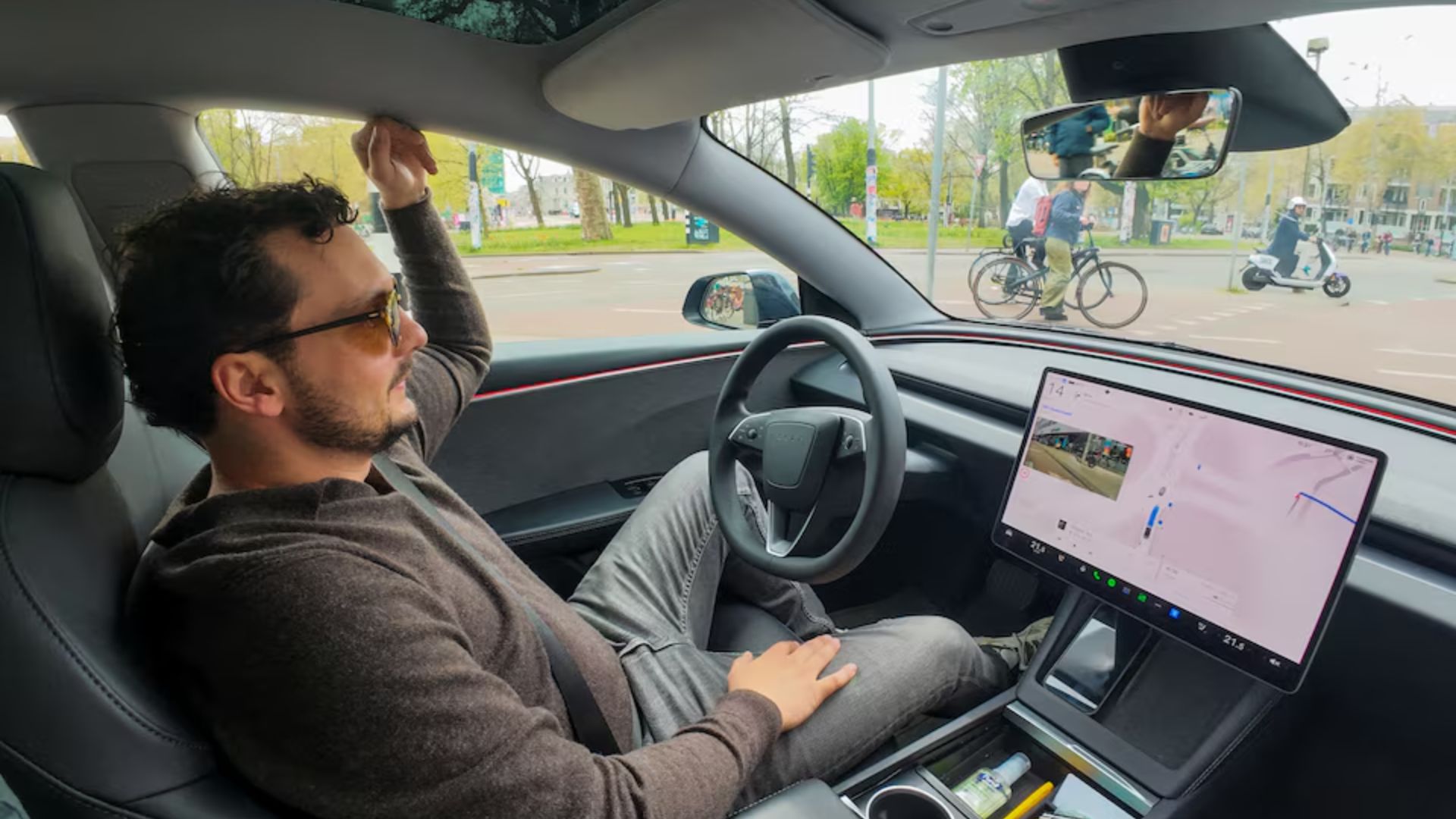
AMSTERDAM, (Reuters) – As Kees Roelandschap navigates down the narrow canal-side streets of Amsterdam, flanked by the city’s many bicycle riders, it takes a second to realise what’s different: he doesn’t have his hands on the wheel of his dark grey Tesla.
The U.S. electric carmaker gained surprise approval this month in the Netherlands for its supervised full self-driving (FSD) system, in a European first for city streets that could open the door for more near-autonomous vehicles in Europe.
It has divided opinion. Enthusiasts like Roelandschap hail it as a breakthrough and even safer than regular driving, while some cyclists and politicians are caught between caution and optimism as the cars start to hit the country’s roads.
“I’ve driven multiple different versions in the U.S. But to be able to experience it firsthand here in the Netherlands — that’s unreal,” Roelandschap told Reuters as he sat behind the wheel of the car going through the Dutch capital.
“I think this should be approved everywhere in Europe because it will lead to increased safety,” he added, saying that it appeared the European-approved version had more stringent safeguards than the U.S. equivalent.
Tesla’s FSD system can steer, brake and accelerate without hands on the wheel, though a driver must remain attentive and ready to intervene. The European Union is due in May to discuss approving the technology, under investigation for safety concerns in the U.S., throughout Europe.
SELF-DRIVING CARS ‘WILL KEEP THEIR DISTANCE’
On Amsterdam’s streets, where trams, trucks and cars share space with a dense flow of bikes, e-bikes, hefty “fatbikes” and a growing fleet of tiny e-cars, reactions were mixed.
“Cyclists are flowing through traffic, swarming around, going left and right, crossing each other,” said Esther van Garderen, head of the Dutch Cyclists’ Union, adding that the Netherlands was a unique challenge for self-driving.
“We’re not fully assured that these self-driving cars will understand the (road) behaviour.”
Amsterdam transport alderwoman Melanie van der Horst said at a city council meeting after the approval that the city had not had a say in the regulatory process and would monitor the roll-out closely. She added though that the supervising driver means “we don’t need to panic” and the tech could improve safety.
“(However) I can definitely imagine that this raises quite a few concerns and reactions,” she said.
Road traffic deaths in the Netherlands increased 6% to 759 in 2025, with car-cyclist and car-pedestrian crashes responsible for the increase, according to government statistics agency CBS.
” I think safety will be much better because the (self-driving) cars will keep their distance,” said local resident Paul ten Cate.
“I think it will actually be nicer for cyclists to have self-driving cars around,” he added.
‘I’M NOT CONVINCED YET’
The roll-out comes as Tesla bets on driver-assistance to revive slowing European sales, dented by CEO Elon Musk’s divisive political rhetoric that has alienated some consumers. Tesla is the most popular electric car in the Netherlands, with some 100,000 of its Model 3 and Model Y cars on the roads.
In recent years Amsterdam has worked to discourage car traffic in favour of bikes and public transport by closing roads, raising fees, removing parking spaces and imposing a speed limit of 30 km per hour (19 mph) on most streets.
Nina Smiljanic, out on her electric bicycle with her dog alongside her on a leash, said she could see the technology working well in one-way highway traffic, but less so in busy Amsterdam.
“Here in the streets, with all the tourists doing unpredictable things, I think the AI still needs to adapt,” she said. “Maybe in America or on the highway it’s fine, but here I’m not convinced yet.”
Demonstrating his Tesla, Roelandschap showed how the car first issued a warning and then slowed to a stop with its hazard lights blinking after he gazed down at his lap, rather than the road, for too long – a precaution to avoid drivers losing focus.
“I have yet to notice or encounter a difficult road situation here. We have a lot of cyclists trying to overtake us, cyclists coming towards us, cyclists coming from the left. What’s dangerous here?”
Reporting by Marta Fiorin, Bart Biesemans and Toby Sterling; Editing by Adam Jourdan and Keith Weir