

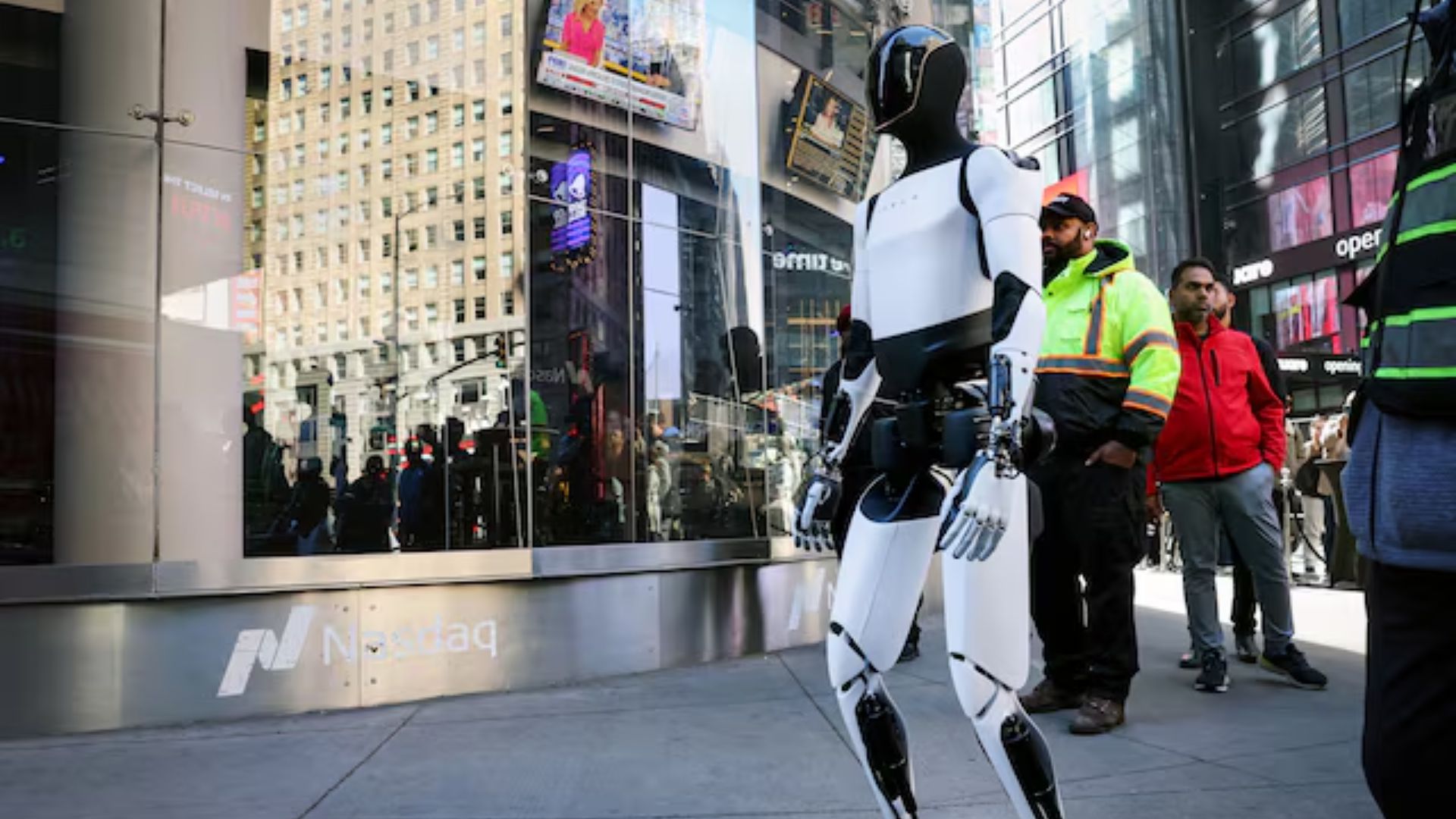
(Reuters) – Humanoid robot production in the US will hit 300,000-400,000 units by 2030 and about 1.5 million units by 2035, J.P. Morgan said on Thursday, as the industry shifts from demonstrations to commercial deployment.
Labor shortages, improving economics and rising production capacity are boosting humanoid adoption in manufacturing, logistics and warehousing, as businesses look to automate repetitive tasks.
- The Trump administration’s finding that imported robotics and industrial machinery pose national security risks could lead to tariffs or other measures to boost domestic production, J.P. Morgan said
- Humanoid deployment is constrained by hardware, AI training data and compute, and production capacity, with most US manufacturers outside Tesla targeting 10,000-30,000 units annually
- The brokerage estimates humanoid robot costs are nearing parity with labor costs, while multi-shift deployment could generate about $100,000 in annual savings per customer
- “Near-term progress remains supply constrained, with a few binding bottlenecks: hands, actuators, the brain, and production capacity,” the brokerage said
- Component suppliers offer the biggest near-term opportunity, J.P. Morgan said, adding it expects the market for key parts such as actuators, motors and vision systems to approach $30 billion by 2035
- Among US humanoid makers, J.P. Morgan highlights Tesla’s Optimus, Agility Robotics’ Digit, Boston Dynamics’ Atlas, Figure AI’s Figure robots, and Apptronik’s Apollo as key players
- J.P. Morgan favors component suppliers including Timken, Robotis, Leader Drive, Orbbec, and Cognex
- The brokerage expects value creation over time to shift toward robot makers and platform integrators
Reporting by Akriti Shah in Bengaluru; Editing by Janane Venkatraman