
By WAF Think Tank
In the automotive industry, leadership changes are rarely just about designations.
Especially at a company as strategically disciplined as Bajaj Auto.
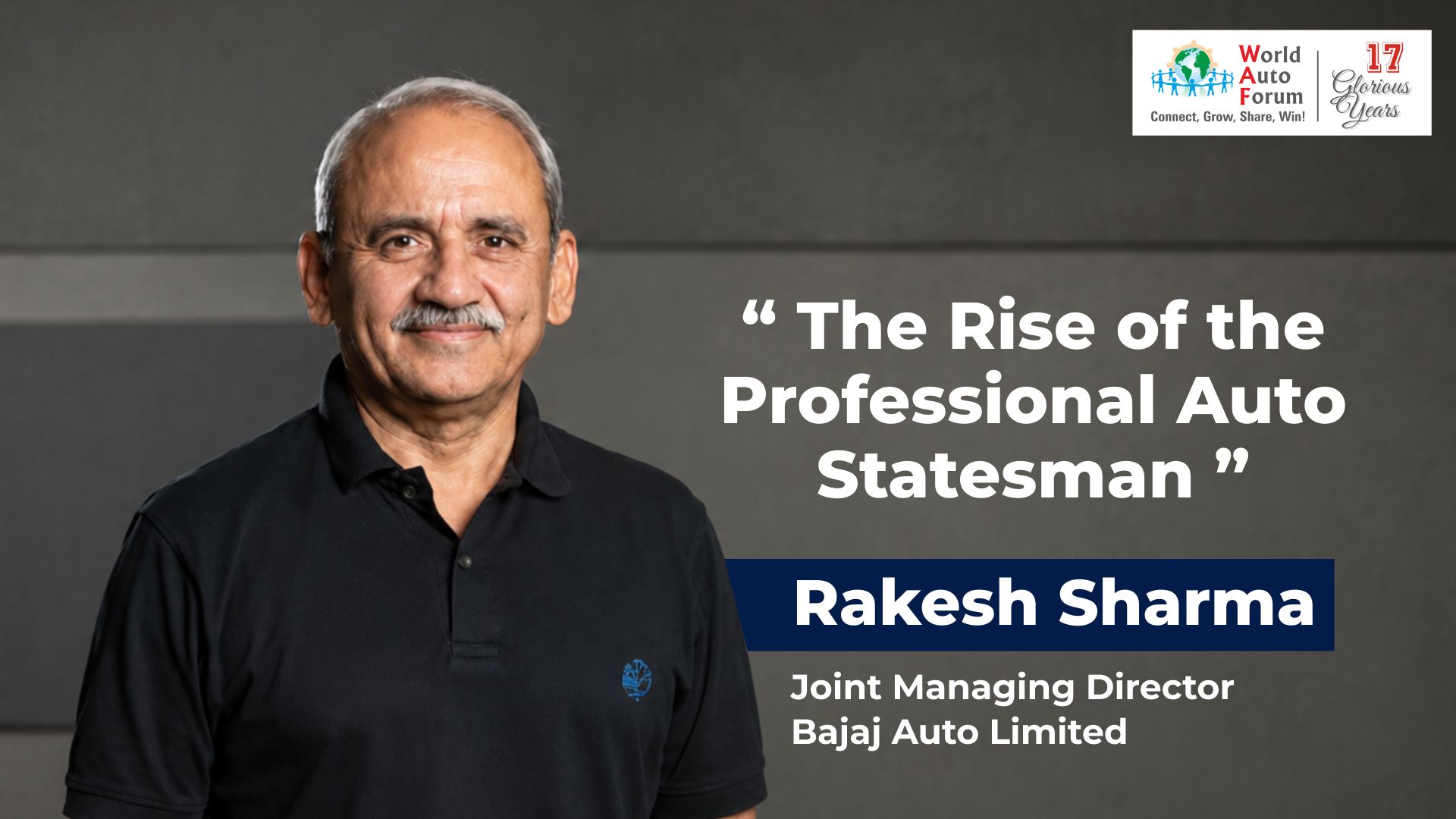
The elevation of Rakesh Sharma as Joint Managing Director is not merely an HR announcement. It is a strong strategic signal from one of India’s most globally respected mobility companies — a signal about continuity, digitisation, exports, execution and future readiness.
For close observers of the Indian auto industry, this move was perhaps expected. For the industry at large, however, it reveals something far bigger as mentioned by Anuj Guglani, CEO, World Auto Forum, ‘The Indian automotive sector is entering an era where operational leaders with global, digital and executional depth are becoming as important as visionary promoters themselves.’
The Rise of the Professional Auto Statesman
Unlike many high-profile industry leaders built around public visibility, Rakesh Sharma represents a quieter but immensely powerful archetype — the long-term institution builder.
Having joined Bajaj Auto in 2007 to lead international business, Sharma played a defining role in strengthening Bajaj’s global footprint across Africa, Latin America, South Asia and several emerging mobility markets.
At a time when many Indian OEMs remained domestically obsessed, Bajaj Auto built a genuinely global commercial architecture.
That did not happen accidentally.
It required:
-
deep distributor ecosystems
-
geopolitical understanding
-
emerging market adaptability
-
razor-sharp cost competitiveness
-
and consistent relationship management across continents.
Those who understand exports know this well:
Global automotive success is not built in boardrooms. It is built in markets.
And few Indian auto executives understand markets like Sharma does.
Why This Move Matters Now
The timing is equally significant.
The automotive industry is currently navigating:
-
EV disruption
-
digital retail transformation
-
software-defined mobility
-
rising geopolitical volatility
-
AI-led operational shifts
-
changing global supply chains
-
and fierce Chinese competition.
Against this backdrop, Bajaj Auto has expanded Sharma’s responsibilities to include Digital & IT and Legal functions alongside core business operations.
This is crucial.
Because modern automotive leadership is no longer only about manufacturing excellence.
It is increasingly about:
-
digital ecosystems
-
data infrastructure
-
compliance velocity
-
platform scalability
-
and technology-led governance.
In many ways, this elevation reflects the emergence of the “hybrid automotive leader” — someone who understands both commercial execution and technological transformation.
The Rajiv Bajaj Factor
One cannot analyse this move without understanding Rajiv Bajaj.
Over the years, Rajiv Bajaj has cultivated one of the most intellectually independent leadership cultures in Indian automotive history. Whether on EVs, manufacturing, skilling or market positioning, Bajaj has consistently taken contrarian yet calculated positions.
Importantly, Bajaj Auto has never appeared promoter-fragile. That is surely rare in India!
The elevation of Sharma reinforces an important governance message:
Strong promoter-led companies become enduring institutions only when they empower professional leadership at the highest levels.
This is succession maturity and Not succession anxiety.
A Larger Industry Lesson
Indian automotive companies today face a critical challenge:
Can they build globally respected institutions beyond promoter charisma?
Because the next decade will not reward companies merely for legacy.
It will reward:
-
adaptability
-
globalisation
-
technology integration
-
leadership depth
-
and organisational resilience.
In that context, Bajaj Auto’s decision appears less like a promotion and more like a structural strengthening exercise.
It also reflects an increasingly visible trend across India Inc:
The rise of deeply experienced operator-leaders who combine legacy understanding with future-facing execution capability.
WAF Think Tank Take
The Indian auto industry is entering a defining decade.
The winners will not simply be the companies with the best EVs or the biggest gigafactories!
They will be the companies with:
-
resilient & deeper leadership pipelines
-
globally mature, inclusive and sensitised operating cultures
-
digital intelligence which delivers and doesn’t just sit in dashboards.
-
and institutional continuity aka consistent growth and continuous improvement!
The elevation of Rakesh Sharma may look like a boardroom development on the surface.
But underneath, it is a reminder that the future of mobility leadership will belong to those who can combine:
experience with adaptability,
strategy with execution,
and legacy with transformation and agility.
And Bajaj Auto appears to understand that better than most.