
by WAF Think Tank
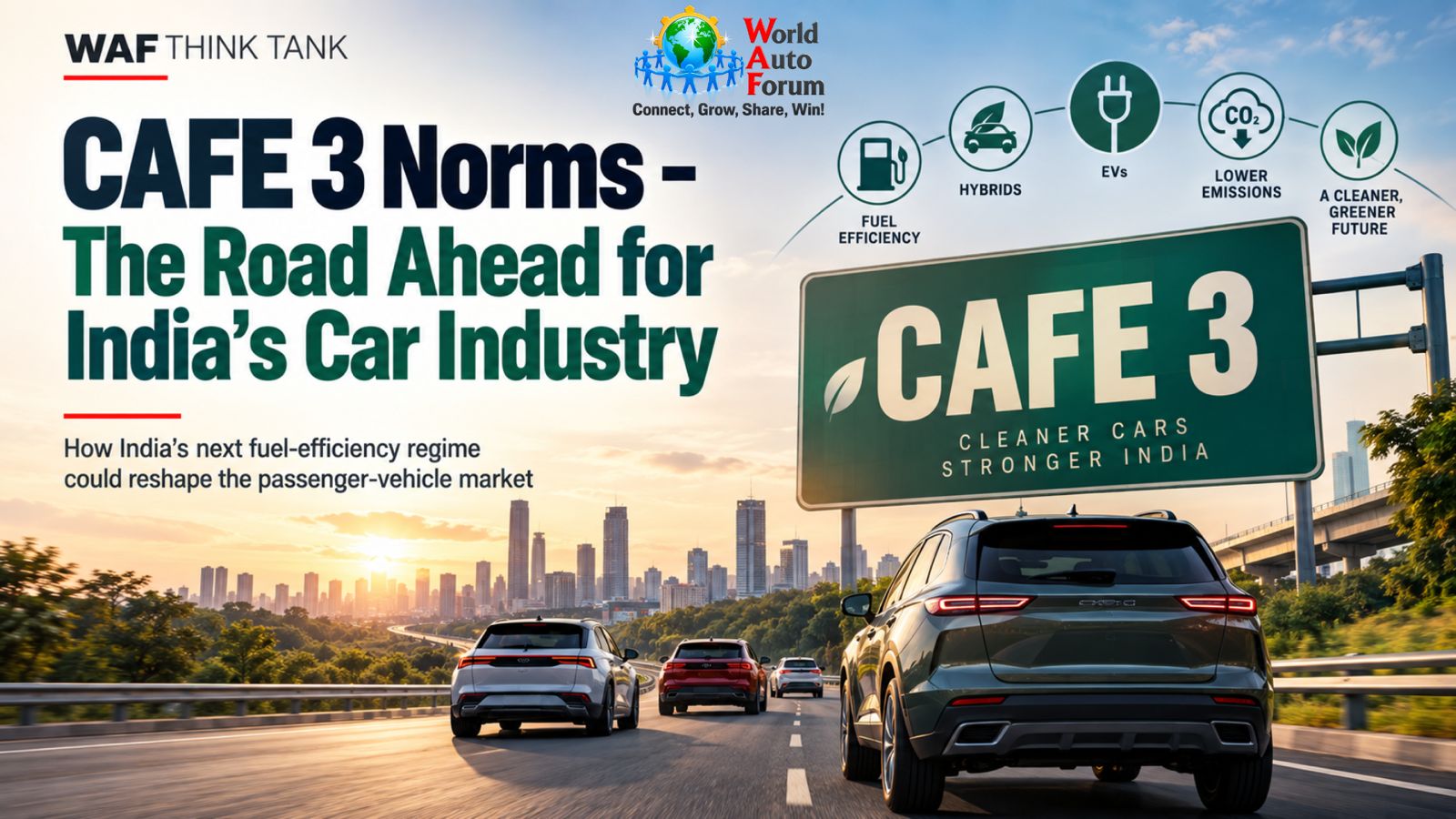
Understanding how India’s next fuel-efficiency regime could reshape the passenger-vehicle market
India’s passenger-vehicle industry is approaching another significant regulatory transition. From 1 April 2027, the third phase of Corporate Average Fuel Economy regulations, or CAFE 3, will govern fleet-level fuel-efficiency performance for passenger vehicles.
At first glance, CAFE 3 is another technical compliance requirement. Its implications, however, extend much further.
The regulation arrives at a time when Indian consumers are moving towards larger SUVs, manufacturers are investing heavily in electric vehicles, hybrids are gaining attention and the cost of meeting increasingly demanding safety and emissions standards is rising.
CAFE 3 will therefore influence not only how efficiently individual vehicles are engineered, but also how manufacturers construct their overall product portfolios.
What CAFE 3 actually regulates
CAFE regulations work at the manufacturer fleet level.
Rather than prescribing a single fuel-consumption number for every car, the framework establishes a target for the average performance of an OEM’s eligible passenger-vehicle fleet, taking vehicle volumes and other prescribed parameters into account.
This distinction matters.
A manufacturer can continue selling vehicles with different levels of fuel consumption. What matters is whether the overall fleet achieves the applicable target.
The regulation consequently turns fuel efficiency into a portfolio-management issue.
A manufacturer selling relatively large SUVs, for example, can offset part of their impact through a greater contribution from efficient ICE vehicles, hybrids or BEVs.
This makes CAFE fundamentally different from a regulation focused on one model or one engine.
Why CAFE 3 is arriving at an interesting time
The Indian car market has changed considerably since the first CAFE regime was introduced.
Small hatchbacks are no longer the unquestioned centre of the market. SUVs and crossovers have become increasingly important, while consumers are also demanding more equipment, greater performance and higher safety standards.
These trends have consequences for vehicle mass and energy consumption.
At the same time, electrification is developing rapidly, although adoption differs substantially across vehicle segments and price points.
CAFE 3 therefore has to operate within a market where consumer demand, engineering trends and environmental regulation are not always moving in the same direction.
The industry’s response will depend on how manufacturers balance these competing pressures.
The 3X BEV factor changes the equation
One of the most consequential provisions in CAFE 3 is the 3X weighting for battery-electric vehicles in the compliance calculation.
This gives BEVs significance beyond their actual sales volume.
For an OEM, increasing EV sales can improve its fleet-level compliance position disproportionately compared with selling the same number of conventional vehicles.
This creates an additional commercial incentive to expand BEV portfolios.
The important point, however, is that CAFE 3 does not make BEVs the only route to compliance.
That distinction will matter enormously in India.
Why hybrids could become more important
India’s passenger-vehicle market is unlikely to move from conventional engines to fully electric vehicles in one uniform step.
Charging availability, purchase price, driving patterns, regional differences and consumer preferences all affect the pace of EV adoption.
Hybrids occupy an intermediate position.
Strong hybrids can substantially reduce fuel consumption while retaining the convenience of liquid-fuel refuelling. For manufacturers, they also provide a way of improving fleet efficiency without depending entirely on BEV demand.
CAFE 3’s treatment of different powertrain technologies therefore creates room for a multi-pathway transition.
The likely result is not an immediate replacement of ICE vehicles, but a more complex powertrain mix.
The SUV challenge
The growing popularity of SUVs presents one of the clearest structural challenges.
SUVs tend to be heavier and have larger frontal areas than traditional small hatchbacks and sedans. Many also use larger wheels, more powerful engines and higher levels of equipment.
Meanwhile, the CAFE framework places considerable importance on vehicle characteristics including fleet mass.
Manufacturers therefore face an engineering challenge:
How do you continue developing the products consumers increasingly want while reducing their fleet’s energy consumption?
The answer is likely to involve several technologies rather than one breakthrough.
Improved engines and transmissions, hybrid systems, lightweight materials, aerodynamic optimisation, regenerative braking and electrification can all contribute.
Weight becomes an engineering priority
The importance of mass deserves separate attention.
Modern cars are carrying more technology than previous generations. Safety systems, larger batteries, ADAS hardware, larger infotainment displays, powered equipment and bigger wheels all add weight.
Some of these additions are directly driven by regulation or consumer expectations.
The industry must therefore improve efficiency while simultaneously accommodating additional equipment.
This could accelerate investment in:
- lightweight materials
- structural optimisation
- smaller and more efficient components
- aerodynamic improvements
- battery and power-electronics efficiency
- energy-management software
In other words, CAFE 3 could influence vehicle engineering even where the consumer does not see an obvious change in the showroom.
The small-car dilemma
There is a second, less visible issue.
India still needs affordable cars, but producing an entry-level vehicle has become considerably more expensive.
Safety requirements, emissions technology, electronics and increasingly sophisticated features have raised manufacturing costs.
At the same time, consumers have been shifting towards SUVs and crossovers.
The final CAFE 3 framework does not retain the special small-car concession proposed in earlier versions.
This leaves manufacturers with a difficult commercial equation:
How do you build an affordable entry-level vehicle that is simultaneously safe, efficient, compliant and commercially viable?
The answer could influence the future of India’s entry-level passenger-car market.
CAFE compliance becomes a portfolio strategy
CAFE 3 effectively changes the conversation inside an automobile company.
Product planning can no longer be separated entirely from regulatory planning.
A new SUV, hybrid or EV has implications for the manufacturer’s wider fleet.
This means an OEM may increasingly evaluate a product on several dimensions:
customer demand + profitability + technology investment + regulatory contribution.
A high-volume EV programme, for instance, can have implications for the manufacturer’s ability to maintain other products in its portfolio.
Similarly, an efficient hybrid could provide a different form of fleet benefit while addressing customers who are not yet ready for a full EV.
The regulatory framework consequently becomes part of the product-planning equation.
Credits add another layer
CAFE 3 also provides a mechanism for manufacturers that outperform their targets to generate compliance benefits, while manufacturers that fall short can use the prescribed credit mechanisms to address their obligations.
This introduces a new economic dimension to efficiency.
Fleet efficiency is no longer simply an engineering objective.
For an OEM, exceeding its target can create regulatory headroom, while persistent underperformance can create an additional cost.
Over time, this could make compliance performance an increasingly important consideration in corporate and product strategy.
What could change in the showroom?
The effects of CAFE 3 will ultimately become visible to consumers.
The most likely changes include a broader range of electrified powertrains, more efficient conventional engines and greater use of technologies designed to reduce energy consumption.
But the impact will not be identical across segments.
In premium vehicles, manufacturers may have greater scope to absorb the cost of additional technology.
In mass-market vehicles, the challenge is different: every additional component has to be justified against a highly price-sensitive customer.
This could make the cost of compliance an important competitive variable.
Four possible OEM approaches
Although each manufacturer will develop its own response, four broad strategies are possible.
1. EV-led
Rapidly expand BEV volumes and use their favourable regulatory weighting to improve fleet performance.
2. Hybrid-led
Use strong hybrids as a major route to lower fleet fuel consumption while maintaining conventional refuelling.
3. Multi-powertrain
Combine ICE, hybrids and BEVs according to the economics and requirements of individual segments.
4. ICE optimisation
Continue improving conventional powertrains through engine, transmission, weight and aerodynamic technologies while gradually increasing electrification.
Most major manufacturers are likely to use some combination of these approaches rather than rely exclusively on one.
CAFE 3 in the context of India’s wider transition
CAFE 3 should not be considered in isolation.
The passenger-vehicle industry is simultaneously dealing with the transition towards E20 fuel, tighter emissions requirements, increasing safety standards and the gradual expansion of electric mobility.
Each requirement creates its own engineering and investment demands.
For manufacturers, the challenge is therefore becoming increasingly multidimensional.
The modern Indian car has to be:
safe, efficient, compliant, affordable, technologically competitive and attractive to consumers.
Meeting all six requirements simultaneously is the real industry challenge.
What to watch between 2027 and 2032
The CAFE 3 period could provide several important signals about the future direction of the Indian car market.
EV penetration
The pace at which BEVs move beyond early-adopter segments will determine how valuable their regulatory weighting becomes in practice.
Hybrid adoption
If hybrids achieve significant consumer acceptance, they could become an important bridge technology during the transition.
SUV mix
Continued SUV growth will test manufacturers’ ability to offset higher vehicle mass and energy consumption elsewhere in their portfolios.
Entry-level vehicles
The economics of affordable small cars will remain an important indicator of how regulation is affecting mass-market mobility.
Technology costs
The degree to which batteries, power electronics, hybrid systems and lightweight materials become cheaper through scale and localisation will influence how much of the compliance cost reaches consumers.
Compliance economics
The development and use of CAFE credits could become an increasingly important part of OEM strategy.
The road ahead
CAFE 3 is ultimately less about any single technology than about how India’s automobile industry manages the transition to lower energy consumption.
The regulation does not require every manufacturer to follow the same technological route.
Instead, it creates a framework in which OEMs must balance their product mix against increasingly demanding fleet-efficiency objectives.
That is particularly significant for India because the market is simultaneously becoming more SUV-oriented, more feature-rich and more electrified.
The next five years could therefore see a more diverse powertrain landscape rather than a simple transition from petrol and diesel to electric.
Efficient ICE vehicles, hybrids, plug-in technologies and BEVs are likely to coexist, with their relative importance determined by regulation, economics and consumer demand.
For manufacturers, the central question will not simply be how to make one efficient car.
It will be:
How do you build an entire portfolio that consumers want — while meeting the efficiency requirements of the future?
That is the strategic challenge CAFE 3 places before India’s car industry.
And it is one that will increasingly shape product development, technology investment and competition through the second half of this decade.
This article is intended as an industry explainer and does not constitute regulatory or legal advice.