

Summary
- Chinese open-source AI overtaking US models in data collection, report says
- China best positioned to benefit from shift towards physical AI
- Some Western firms prefer low-cost Chinese models
BEIJING, (Reuters) – The dominance of China’s open-source artificial intelligence is creating a “self-reinforcing competitive advantage”, allowing it to challenge U.S. rivals despite restricted access to advanced AI chips, a U.S. congressional advisory body said on Monday.
Driven by their cheaper cost, Chinese large language models from firms including Alibaba (9988.HK), Moonshot and MiniMax (0100.HK) now dominate worldwide usage rankings on platforms like HuggingFace and OpenRouter.
Beijing’s push to deploy AI throughout a wide range of sectors to upgrade its manufacturing base, factories, logistics networks and robotics is generating real-world data that feeds back into model improvement, the report said.
“This open ecosystem enables China to innovate close to the frontier despite significant compute constraints,” the U.S.-China Economic and Security Review Commission wrote in a report published on Monday.
“Chinese labs have narrowed performance gaps with top Western large language models,” it added.
U.S. lawmakers have imposed successive rounds of export restrictions on China since 2022, banning them from acquiring the most advanced AI chips, though Washington approved exports of Nvidia’s (NVDA.O) second-most advanced chip in December.
U.S. companies including ChatGPT developer OpenAI and Anthropic, creator of Claude, as well as traditional tech giants have, meanwhile, invested billions of dollars to remain at the forefront of the new technology.
But their position could be under threat.
“Open model proliferation creates alternative pathways to AI leadership,” the report said.
CHINA POISED TO CAPITALISE ON SHIFT TO EMBODIED AI
Some estimates suggest that around 80% of U.S. AI startups now use Chinese open-source AI models.
DeepSeek’s groundbreaking R1 model launched last year quickly overtook ChatGPT as the most downloaded model on the U.S. App Store. And Alibaba’s Qwen family of models has surpassed Meta’s (META.O) Llama in global cumulative downloads, according to HuggingFace.
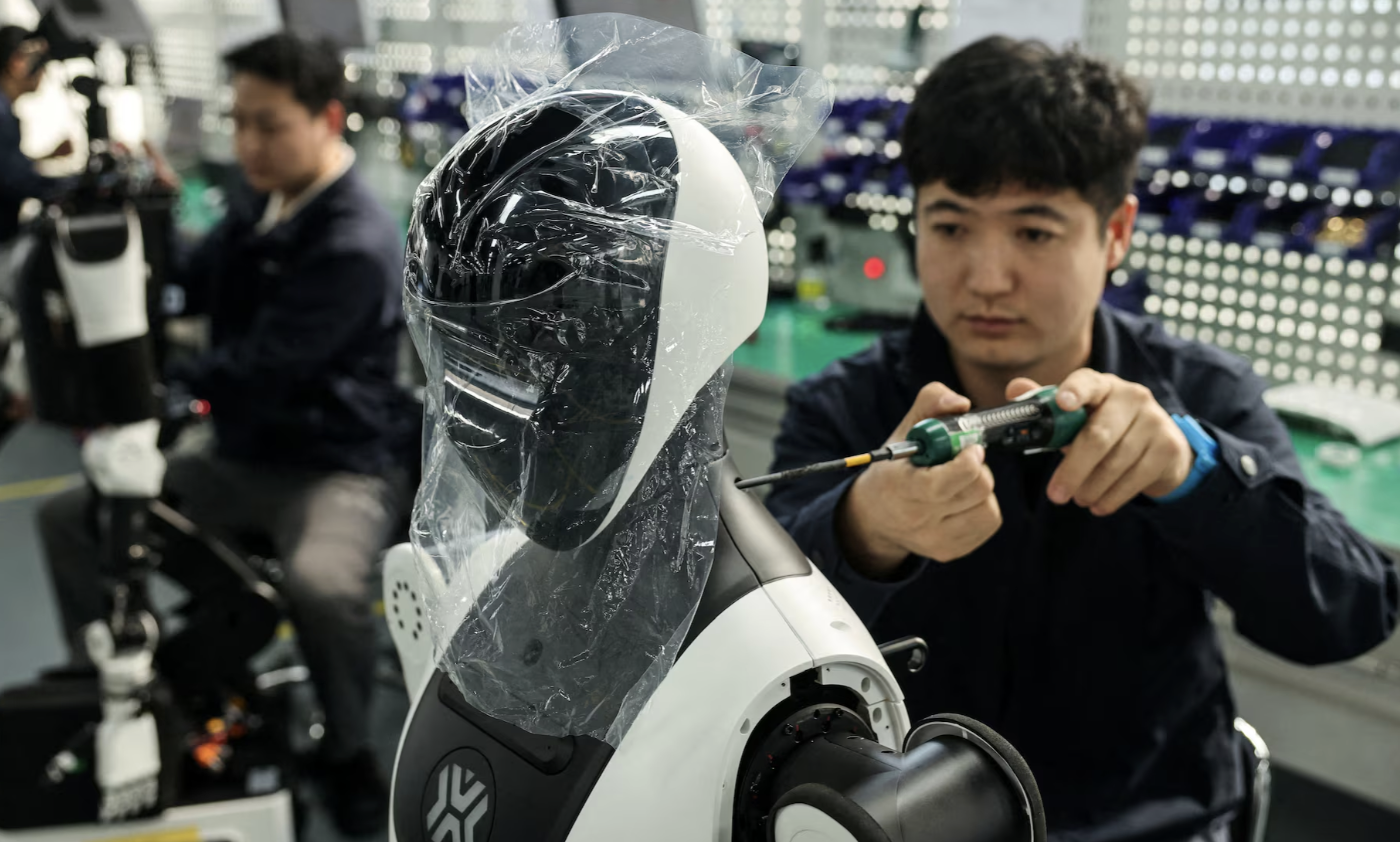
As AI’s frontiers shift from large language models towards agentic AI and physical, or embodied, AI, China may be better positioned to capitalise on its mass data collection efforts to boost development of humanoid robots, autonomous driving software or even dual-purpose technologies, the report said.
“There’s a bit of a deployment gap in the embodied AI space between the U.S. and China. That’s something that over time compounds itself … We’re starting to see that compounding now,” Michael Kuiken, the commission’s vice-chair, told Reuters in an interview.
The commission is also watching how China uses AI in sectors like biotech, quantum computing and advanced materials, he added.
Beijing has designated embodied AI as a core future strategic industry, and many leading Chinese humanoid robotics firms plan public listings this year.
Despite warnings from some Western research organisations of the potential security risks of an over-reliance on Chinese open-source AI models and their political bias towards Chinese government positions, many companies are adopting them anyway.
Siemens (SIEGn.DE) CEO Roland Busch said earlier on Monday that there were “no disadvantages” to using Chinese open-source AI to train the German company’s AI models specialised for industrial automation, citing their cost advantage and ease of customising parameters.
Reporting by Laurie Chen; Editing by Joe Bavier