
BEIJING, (Reuters) – Call it a different kind of sticker shock.
The Beijing Auto Show that opened to the public this week is a showcase for how hypercompetition in China has driven new car prices in the world’s largest car market to a fraction of the level of the next-largest market, the U.S.
The contrast is stark.
The average new car in the U.S. in March had a list price of $51,456, according to Kelley Blue Book.
In China, there are more than 200 battery-powered models, including hybrids, for sale at less than the equivalent of $25,000, according to DCar, an information and trading platform.
Reuters compiled a list of the five best-selling electric vehicles in China that start under $12,000 using DCar data.
These small EVs aren’t available for sale in American showrooms – and may never be – but for about the price of an average new car in the U.S., a consumer in China could buy all five of these EVs.
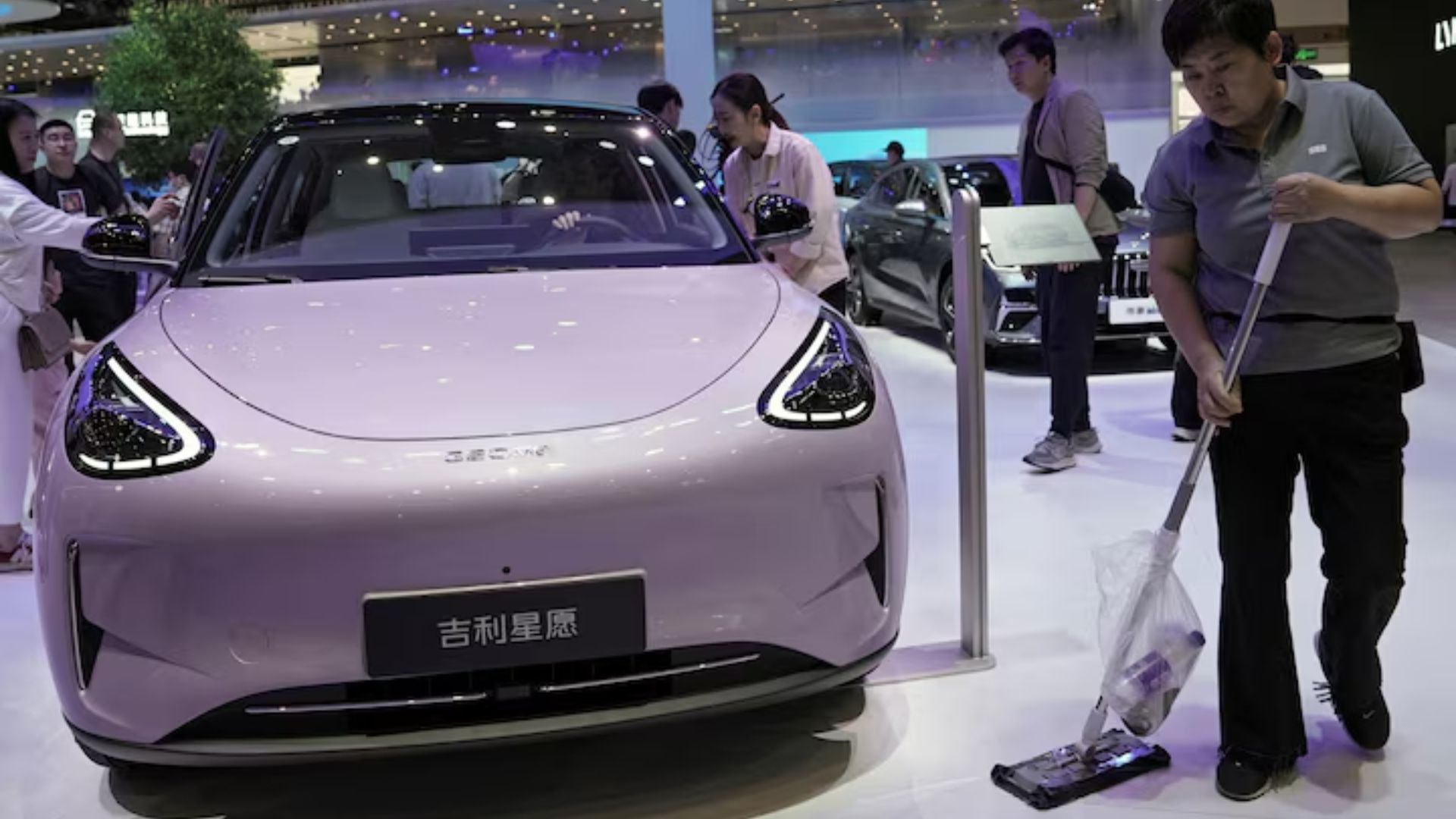
Geely EX2: Starting price, $10,060

The pure electric Geely EX2 was the top-selling model domestically for any kind of vehicle in 2025.
The small EV comes with a bevy of nifty features: a front trunk, storage compartments throughout the cabin and a 14.6-inch central touchscreen running on a system that Geely developed. The top-trim version has a range of about 255 miles on the Chinese test standard.

Known as the “Star Wish” in China, the EX2 was a hit from its 2024 launch and Geely began sales in Brazil, Indonesia and Thailand last year.
“When you get in, you don’t feel like you are in a small car,” auto analyst Felipe Munoz said. “It feels better in terms of quality and bigger in terms of size.”
Wuling Hongguang MiniEV: Starting price, $6,560

Of the top-selling budget EVs, the MiniEV leans heaviest on the cheap-but-cheerful aesthetic of older, low-cost cars.
Wuling has stretched the micro car for 2026 to accommodate four doors and a bit more seating room in the back for adults. But the boxy city car remains tiny by American standards.
You could park two of the previous-generation MiniEVs in the space needed for a regular Ford F-150, the top-selling U.S. vehicle.
Marketed for its cute quotient and cost, the basic model has a top speed equivalent to just 62 miles per hour and a China-rated battery range of just 127 miles.
Wuling also has a larger subcompact EV that starts at just over $8,000 in China. The retro-looking Bingo Pro is designed for highway travel with a battery range of 250 miles based on Chinese testing standards.
BYD Seagull: Starting price: $10,200
BYD Yuan UP: Starting price: $10,945

BYD Qin Plus DM: Starting price: $11,675
BYD is China’s biggest player in small EVs. The firm’s top three models starting under $12,000 accounted for 700,000 vehicle sales over the past 12 months in China.
The Seagull was an immediate sensation when it was released three years ago, stunning analysts with its performance, styling and above all its price.

The 2026 Seagull comes with an optional lidar remote sensing system for driving assistance including automated lane changing, a new fast-charge feature and a battery range of about 314 miles on the premium version, according to Chinese testing standards.
BYD economized on the Seagull at launch by equipping it with a single “monoblade” windshield wiper. Some analysts hailed that as a smart way to make savings. Some drivers complained it did not handle heavy rain.
The 2026 model gets a standard set of two wipers.

Reporting by Qiaoyi Li, David Dolan and Kevin Krolicki; Editing by Thomas Derpinghaus