

(Reuters) – Ford Motor (F.N), announced a $19.5 billion charge on electric-vehicle investments on Monday, the most visible sign to date of the auto industry’s pullback from a technology carmakers wholeheartedly embraced early this decade.
Much of that sum reflects expenses related to canceling fully electric models that had been years in the making. Ford is shifting much of its focus to expanding conventional gas models as well as hybrid vehicles in an effort to better match the preferences of American car buyers.
Here are some notable aspects of Ford’s announcement:
WHAT’S IN THE WRITEDOWN?
About $8.5 billion is tied to costs associated with killing several future EVs, including a planned large pickup truck that was to be built in Tennessee. Ford also is writing down $6 billion from a joint-venture battery operation with South Korea’s SK On – that company announced the end of the partnership last week.
Ford described another $5 billion as “additional program-related expenses.” Of the total charges, only about $5.5 billion will impact cash, which Ford said would be incurred next year and into 2027.
EV MODELS SCRAPPED
Ford is effectively scrapping all of its next-generation electric vehicles, including the large pickup as well as some commercial vans. That Tennessee plant, which was envisioned to eventually crank out 500,000 EV trucks when Ford announced details of the manufacturing complex in 2023, now will build gas-powered trucks.
That leaves Ford’s EV strategy focused on a family of more affordable models that a so-called skunkworks team in California has been developing. The company has said the first model from that effort will be a midsize pickup truck, to be priced around $30,000 when it goes on sale, set for 2027.
CUTTING LOSSES
Like nearly every traditional automaker, Ford has been losing money on its EV operations – $5 billion in 2024, and likely billions more this year. A major factor is the high cost of batteries, which have not declined as fast as expected, auto executives have said.
In effect, the company is cutting its losses by incurring big charges now. Reducing its exposure to money-losing EVs should help its bottom line in coming quarters. Executives said the EV business should become profitable in 2029.
HYBRIDS IN FOCUS
Ford said hybrid cars, which use gas engines along with batteries to improve power and fuel efficiency, will drive growth in coming years. The company expects its global mix of hybrids, extended-range EVs and pure EVs to reach 50% of vehicle sales by 2030, from 17% today.
That’s according to an analysis performed for Reuters by compensation and governance specialist Equilar.
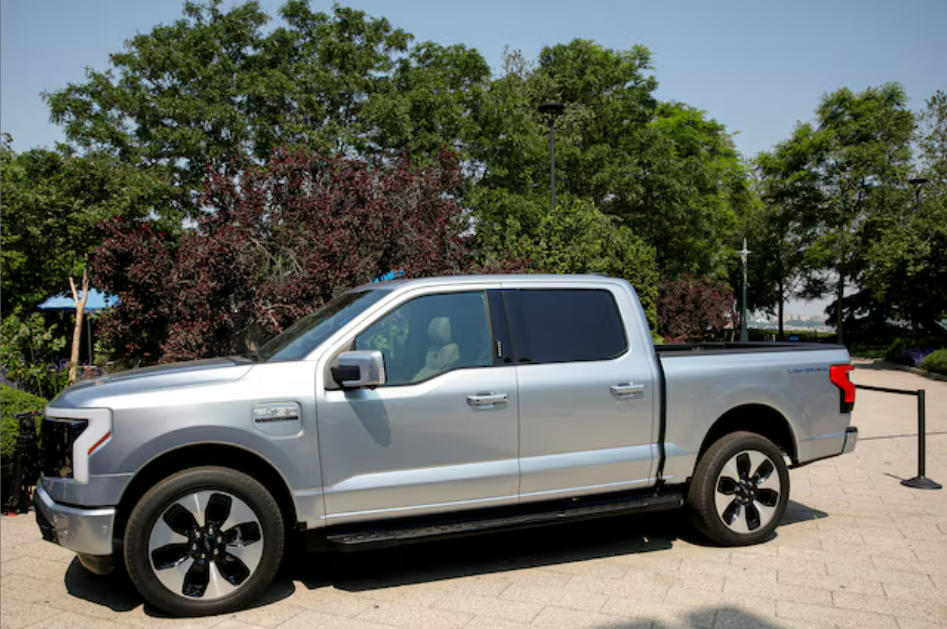
One example: the Ford F-150 Lightning, a fully electric truck on sale since 2022, which Ford says will eventually be remade into an extended-range electric truck. That setup will include a gas-powered generator that would charge the battery on the go, offering the driver 700 miles of range without needing to recharge or refuel.
BATTERY STORAGE BOOM
Ford will use factories in Kentucky and Michigan to make batteries for energy-storage services, which are in high demand from data centers tied to the artificial intelligence boom. The company described it as a new business that would include sales and service, and said it would invest $2 billion to launch the operation over the next two years.
Reporting by Lewis Jackson, Nora Eckert and Christoph Steitz. Editing by Mike Colias, David Goodman and Nick Zieminski