
In the automotive industry, almost every part of a vehicle can be traced through its supply chain, manufacturing process and quality history. But there is one important commercial decision that can often be surprisingly difficult to reconstruct: how exactly did a spare part get its current price?
For many automotive organizations, parts pricing still depends on spreadsheets, disconnected workflows and manual decisions. A price changes, someone reviews and approves it, and eventually the updated number reaches the system.
But months later, when that pricing decision needs to be reviewed, can the organization easily answer:
Who changed the price?
Why was it changed?
What was the previous price?
What cost assumptions were used?
Who approved it?
And more importantly, could the organization confidently reconstruct the entire decision during an audit, dispute or margin review?
This is where structured pricing governance becomes important.
Introducing the Autoclad Suite Pricing Tool
Redsage has launched the Autoclad Suite Pricing Tool, an intelligence layer designed to bring version control, governance, traceability and AI intelligence to automotive parts pricing.
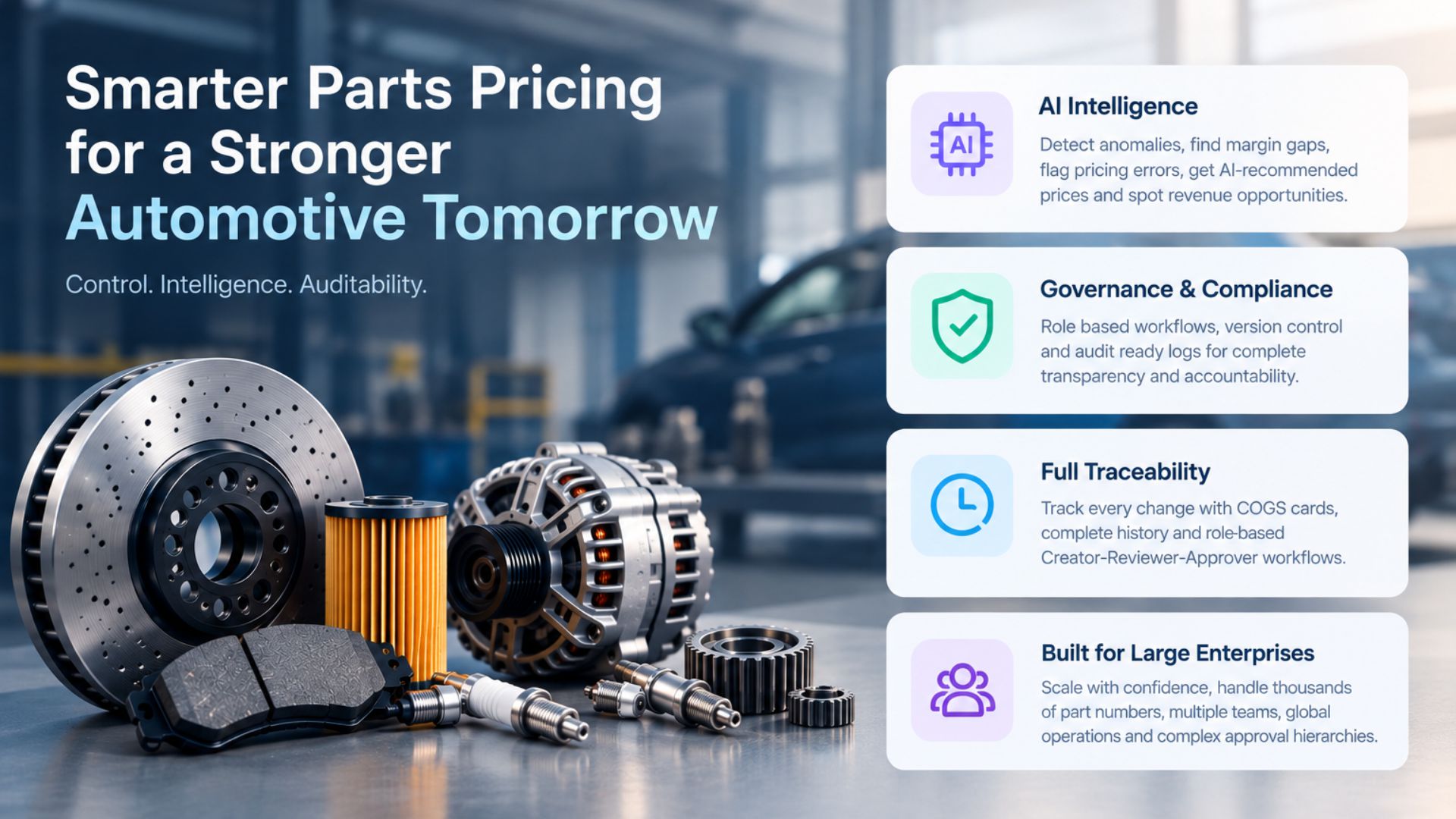
The platform creates a versioned record for every part number, including a COGS Card, complete change history, role-based Creator-Reviewer-Approver workflows and audit-ready logs.
In simple terms, every pricing decision becomes traceable.
Instead of simply knowing what the current price is, organizations can understand the history behind that price and the decisions that led to it.
Because in an increasingly complex automotive aftermarket, a price should not simply exist in a system.
Its history should exist too.
Making Every Pricing Decision Traceable
Pricing decisions can involve multiple people, cost assumptions, approvals and changes over time. When these activities are spread across different files and workflows, reconstructing the complete history can become difficult.
Autoclad Suite brings these elements together into a structured pricing record.
Each part number can have its own versioned pricing history, supported by COGS information, change records and role-based Creator-Reviewer-Approver workflows.
This creates a more transparent pricing process where organizations can understand not only the current price, but also how and why that price was reached.
The result is greater control over the pricing lifecycle and a more audit-ready approach to commercial decision-making.
AI for the Mistakes Humans Don’t See
Managing pricing for thousands of part numbers creates another challenge: manual reviews cannot consistently identify every anomaly.
People can review pricing data, but identifying every inconsistency, margin gap or calculation issue across a large number of part numbers becomes increasingly difficult.
Autoclad Suite applies AI to surface issues and opportunities across the pricing process.
This includes:
- Superseded-part inconsistencies
- Margin gaps and outliers
- Pricing calculation errors
- AI-recommended pricing
- Competitor part-price comparison
- Revenue optimization opportunities
Rather than relying only on manual review, AI can help bring attention to areas that may require further investigation or action.
From a Price in the System to a Decision You Can Explain
Having a current price in a system of record is important. But the current price is only one part of the story.
The bigger question is whether the organization can explain the decision behind that price.
With version control, governance, change history, approval workflows and AI-driven insights, Autoclad Suite is designed to make automotive parts pricing more structured, traceable and intelligent.
Because knowing the current price is one thing.
Knowing how and why you arrived there is another.