

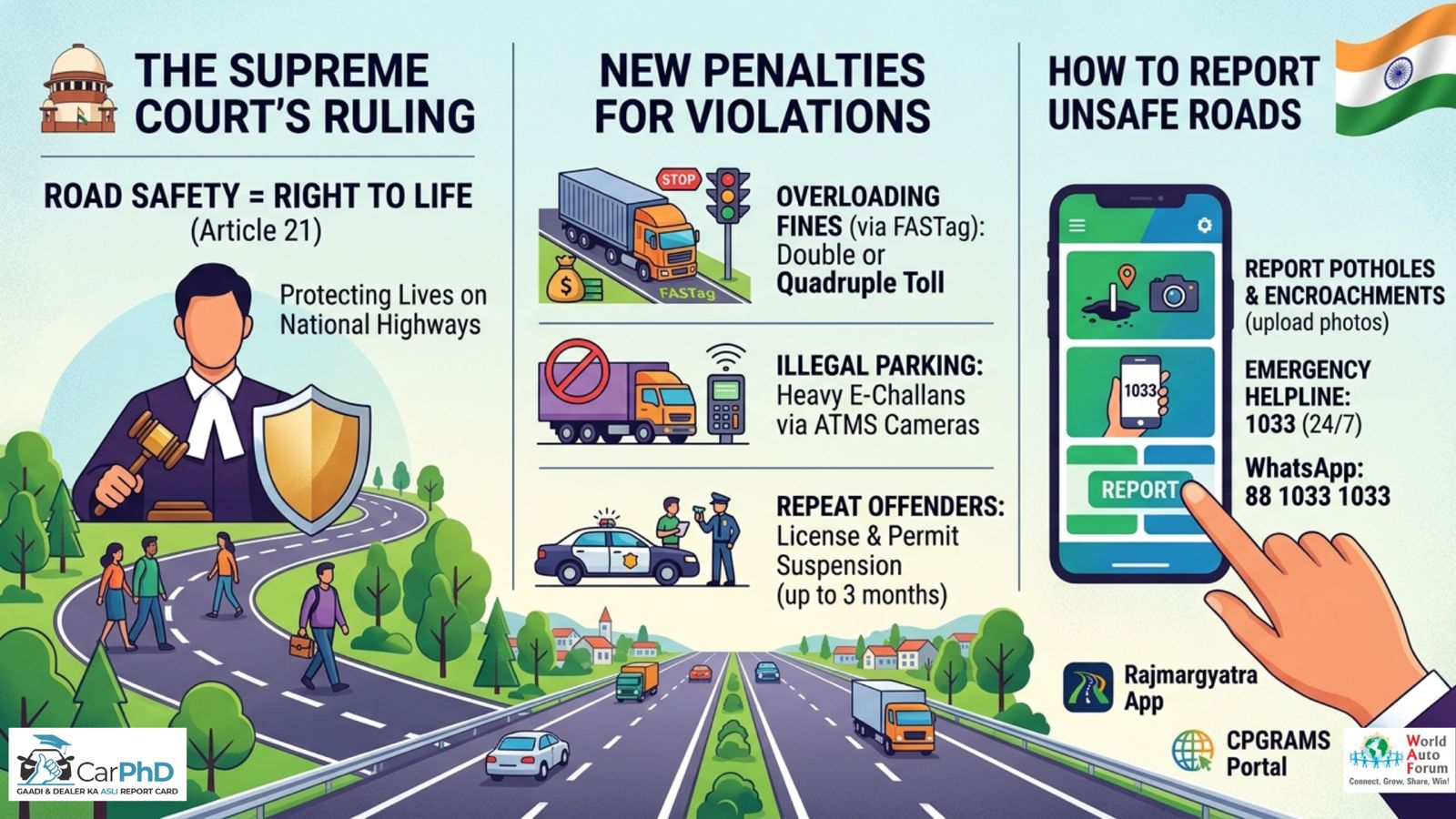
Yes! Finally road safety is now recognised as a fundamental right in India under Article 21 (Right to Life and Personal Liberty). In a landmark ruling in April 2026, a Supreme Court bench of Justices J.K. Maheshwari and Atul S. Chandurkar held that the “safety of a commuter” is an integral part of the right to live with dignity.
The Court declared that safe travel is not just a policy matter but a positive mandate for the State to ensure environments where life is preserved. High-speed expressways were specifically warned against becoming “corridors of peril” due to administrative or infrastructural failures.
Key Nationwide Directions Issued (April 2026)
The Court exercised its powers under Article 142 to issue mandatory pan-India guidelines to reduce road fatalities:
- Ban on Illegal Highway Parking: Heavy and commercial vehicles are strictly prohibited from parking or stopping on national highway carriageways or paved shoulders, except in designated bays or wayside facilities.
- Removal of Encroachments: Unauthorized structures, including dhabas and shops within the highway’s ‘Right of Way’, must be removed within 60 days.
- Emergency Infrastructure: Authorities must deploy Basic Life Support (BLS) ambulances and recovery cranes at intervals of every 75 km on National Highways.
- Blackspot Rectification: High-risk “blackspots” where accidents frequently occur must be identified within 45 days and fixed with better lighting and signage.
- Dedicated Task Forces: District-level Highway Safety Task Forces must be established within 15 days to monitor and audit safety protocols.
- Technology Enforcement: Implementation of Advanced Traffic Management Systems (ATMS), including CCTV cameras, GPS-timestamped photos, and real-time alerts for digital challans, was mandated.
“The Court clarified that financial or administrative constraints cannot be used as excuses by the government for failing to protect human lives on roads.”
Anuj Guglani, CEO World Auto Forum commented,‘ This is a landmark decision of the Honble Supreme Court of India. The National highways account for 2% of roads and 30% of fatalities. This needs to change. Only Supreme Court could have done this! Road safety is now a fundamental right and that’s the beginning to Safer India.’
The Supreme Court’s April 2026 ruling explicitly links road safety to the Right to Life under Article 21, and the government has introduced new penalties and reporting mechanisms to enforce this.Penalties for Violations (As of April 2026)The Court and the Ministry of Road Transport and Highways (MoRTH) have introduced specific financial and legal consequences for highway-related safety violations:
- Overloading Toll Surcharges: Effective April 15, 2026, overloaded vehicles are charged directly via FASTag at toll plazas based on weight:
- 10% to 40% excess load: Double (2x) the base toll fee.
- Above 40% excess load: Four times (4x) the base toll fee.
- Illegal Highway Parking: Heavy and commercial vehicles parked on highway shoulders or carriageways (except at designated bays) face heavy e-challans generated via Advanced Traffic Management Systems (ATMS) using GPS-timestamped photographic evidence.
- Encroachment Penalties: Unauthorized commercial structures like dhabas within the highway’s “Right of Way” must be demolished within 60 days. Authorities are prohibited from issuing or renewing licenses for such sites without NHAI clearance.
- Repeat Violators: In some districts, drivers with more than five serious violations (e.g., drunk driving, over-speeding, or non-use of seatbelts) face a three-month suspension of their vehicle’s registration and route permits.
- Hit-and-Run (Section 106 BNS): Under the Bharatiya Nyaya Sanhita, causing death by negligent driving and fleeing can lead to up to 10 years in prison and a fine. However, if the driver reports the incident immediately, the maximum term is reduced to 5 years.
How to Report an Unsafe Road or Violation –You can now hold authorities accountable and report hazards through these official channels:
- Rajmargyatra App: This is the primary mobile tool for reporting potholes, encroachments, or unauthorized cuts in dividers. You can upload geo-tagged photos directly to the NHAI portal for tracking.
- NHAI Helpline (1033): A 24×7 toll-free number for reporting road crashes, vehicle breakdowns, or highway-related grievances. It is also available via WhatsApp at 88 1033 1033.
- CPGRAMS Portal: For systematic issues (like poorly maintained stretches or recurring safety hazards), you can lodge a formal complaint on the Centralized Public Grievance Redress and Monitoring System (CPGRAMS).
- City-Specific Apps: For urban road issues, use local traffic police apps (e.g., Delhi Traffic Police App or Mumbai Traffic Police App) to report rash driving or obstructive parking.