

by WAF Think Tank
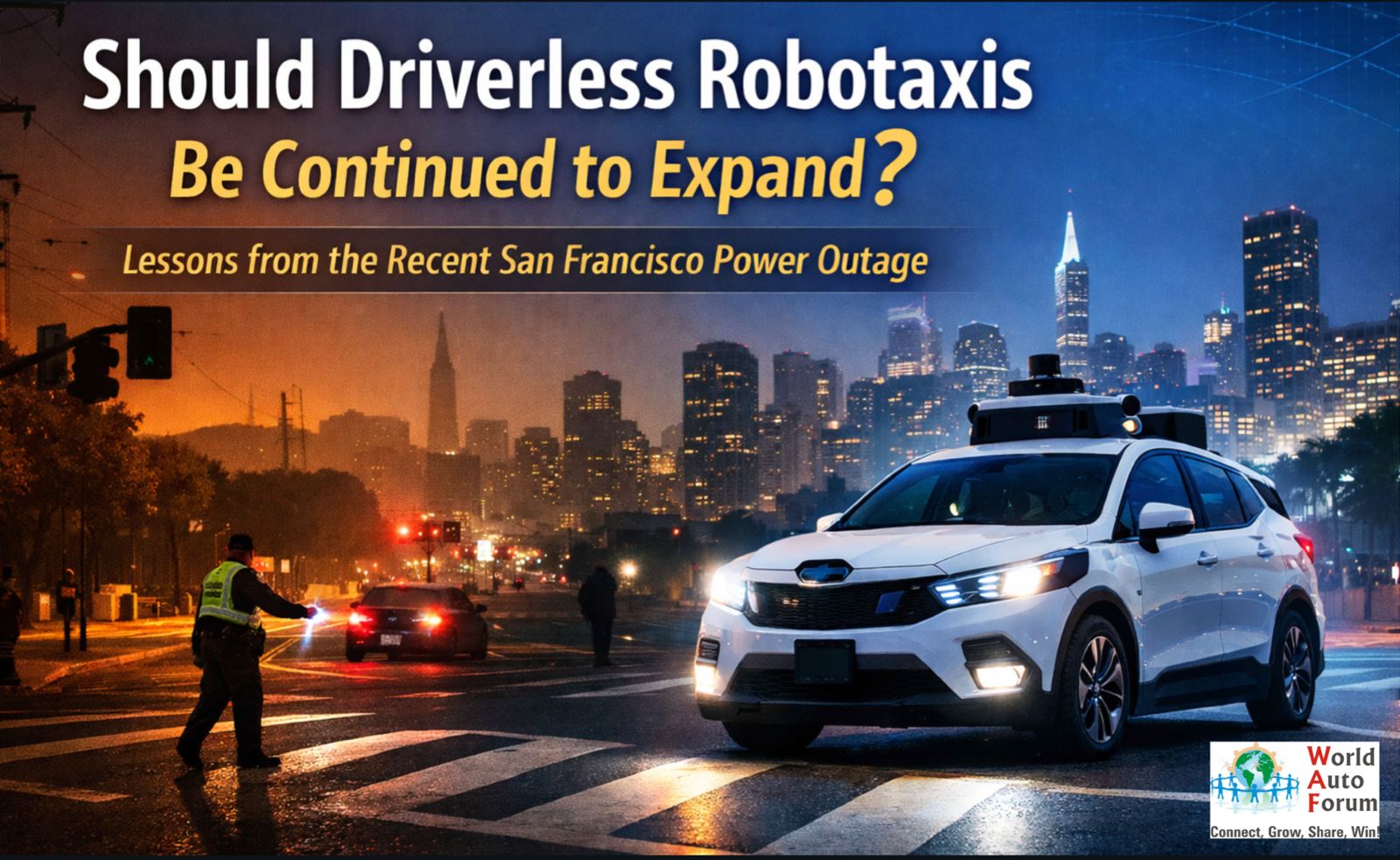
•Last Sat, the fire at the PG&E Substation knocked out power to around one third of the residents in parts of San Francisco
•Waymo, the popular Robotaxi service from Alphabet ( Google’s parent) operates a fleet of around 2,500 Robotaxis in the bay area.
•Traffic Signals went dark and these driverless cars in the affected areas had navigation problems
•Many of these cars were stalled and stranded at intersections further exacerbating the traffic snarls and jams
The promise of driverless robotaxis has long been tied to a vision of safer roads, reduced congestion, lower emissions, and round-the-clock urban mobility. Cities like San Francisco have been at the forefront of this transformation, serving as real-world laboratories for autonomous vehicle (AV) deployment. However, the recent power outage in San Francisco — which disrupted traffic signals, communication networks, and parts of digital infrastructure — has once again raised a critical question: Should the expansion of driverless robotaxis continue at the current pace, or is a strategic pause needed to reassess risks and readiness?
Power Outages: A Reality Check for Autonomous Mobility
Autonomous vehicles depend heavily on a complex ecosystem — high-definition maps, sensors, cloud connectivity, GPS signals, traffic infrastructure, and uninterrupted power supply. While robotaxis are designed with redundancies, large-scale power outages expose systemic vulnerabilities beyond the vehicle itself.
During the San Francisco outage, intersections without functioning traffic lights required human judgment, police intervention, and eye contact between drivers — elements that human drivers instinctively adapt to but autonomous systems still struggle to interpret flawlessly. In such scenarios, robotaxis may behave conservatively, freeze in place, or reroute inefficiently, potentially creating bottlenecks or safety concerns.
This highlights an important truth: autonomous driving does not operate in isolation — it is only as resilient as the city infrastructure supporting it.
Safety vs Scalability
Proponents of robotaxis argue that autonomous vehicles do not get tired, distracted, or impaired — and statistically, they may already be safer than average human drivers in controlled conditions. Yet rare, high-impact events such as power failures, natural disasters, cyber incidents, or infrastructure breakdowns are precisely where public trust is tested.
Rapid expansion without fully accounting for such edge cases risks undermining years of technological progress. A single widely publicized failure can outweigh thousands of uneventful rides in the court of public opinion.
The Human-in-the-Loop Question
The outage also revives the debate around human oversight. Should robotaxi operations include:
- Remote human supervisors with enhanced authority?
- Mandatory on-ground support teams during emergencies?
- Clear protocols for handing over control or safely immobilizing vehicles during infrastructure failures?
Until cities can guarantee near-zero downtime in power and communications — an ambitious goal even for the most advanced urban centers — a hybrid approach may be more pragmatic than full autonomy.
Regulation Must Evolve with Reality
Regulators face a delicate balancing act. Overregulation could stifle innovation, while underregulation may compromise public safety. The San Francisco incident suggests that approvals for expansion should be conditional, linked to:
- Proven performance during infrastructure disruptions
- Transparent disclosure of failure-handling protocols
- Mandatory collaboration with city authorities and utilities
Expansion should be phased, data-driven, and reversible, rather than blanket and irreversible.
So, Should Expansion Continue?
Anuj Guglani, Founder & CEO, WAF Group says, ‘The answer is not a simple yes or no. Driverless robotaxis should continue to expand, but not blindly or uniformly. The recent power outage serves as a timely reminder that technological capability must be matched by infrastructural resilience, regulatory maturity, and public confidence.’
He further added, ‘Autonomy is the future — but resilience is the prerequisite.Waymo now says they are fixing the navigation. Shouldn’t the Robotaxi Cos be curtailed before they pass their requisite tests and compliances! Guess what ? Most of these compliances are still evolving! It surely makes sense to take a breather and plan a bit before letting the machines take over!’
Cities like San Francisco must use such incidents not as reasons to abandon innovation, but as opportunities to strengthen systems, refine policies, and ensure that when driverless mobility scales up, it does so responsibly, safely, and sustainably.
Progress should move forward — but with eyes wide open.