

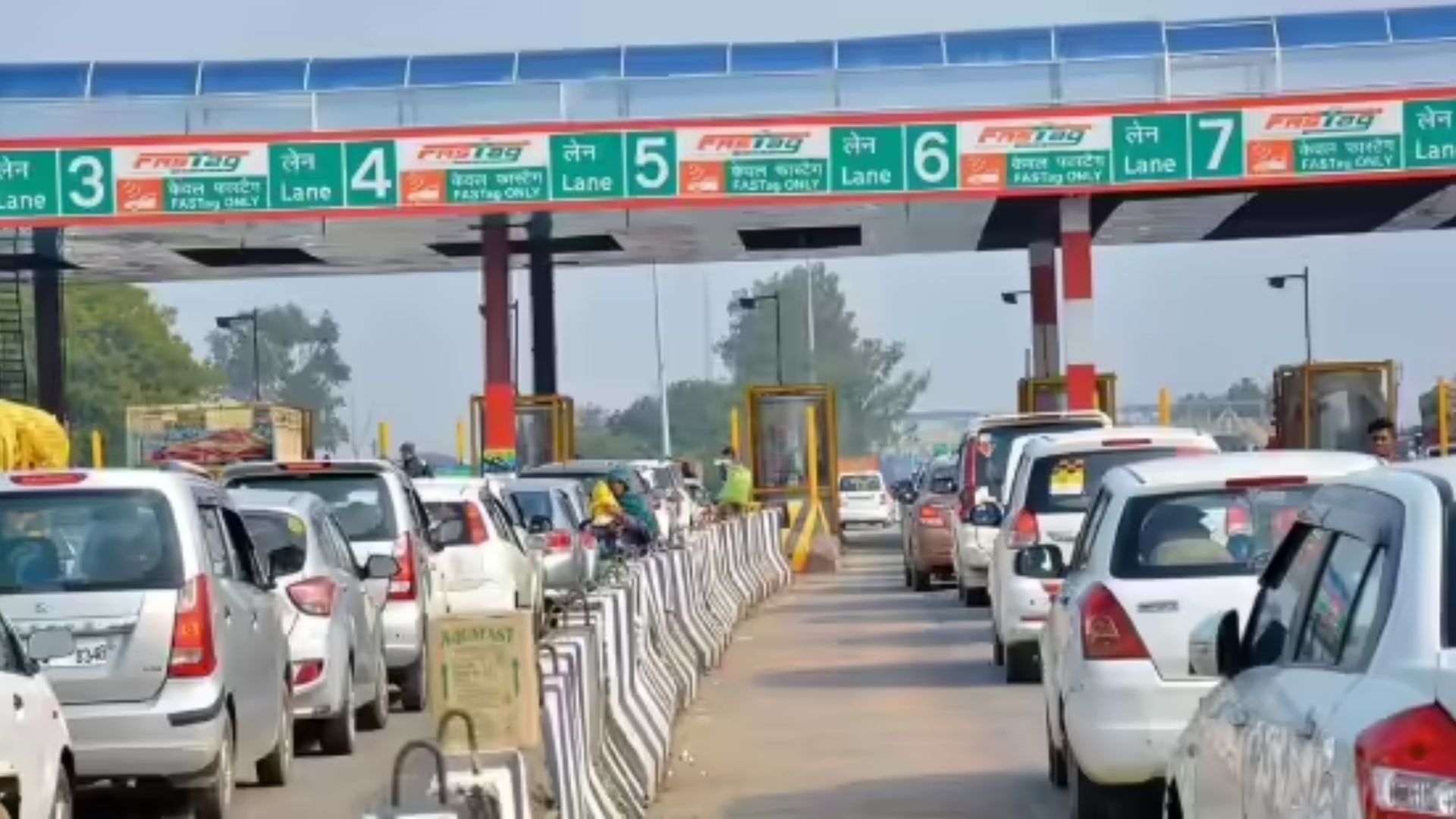
Source : PTI | Vehicles entering the national capital will soon pass through Delhi’s border toll points without stopping as the MCD has initiated introducing a multi-lane free flow toll collection system, reducing traffic and vehicular emissions at the city entry points.
According to the plan, the civic body will upgrade its toll and environmental compensation charge (ECC) collection to an MLFF (Multi-Lane Free Flow) system across its 154 border entry points, officials said on Monday.
Speaking to PTI, a senior MCD officials said, “The proposed system will replace the existing stop-and-pay mechanism with an automated, technology-driven model that combines Radio Frequency Identification (RFID) and Automatic Number Plate Recognition (ANPR) cameras.
He further said that the system will also be embedded with artificial intelligence, and vehicle detection sensors to enable seamless toll collection, similar to the FASTag-based system on national highways.
The officials said the move is intended to tackle long-standing congestion at major Delhi borders where several commercial vehicles queue up daily, leading to delays, fuel wastage and increased pollution.
“We are moving towards an ANPR camera-based toll collection system along the lines of highways, and everything is being done according to the the direction of the Supreme Court,” the official said.
Ensuring that vehicle owners are not required to stop at toll plazas, the new system will automatically deduct taxes similar to the FASTag system on national highways, he said.
Under the proposed arrangement, vehicles equipped with RFID tags will have toll charges deducted automatically while moving through designated gantries without stopping. High-definition ANPR cameras will simultaneously capture vehicle registration numbers for validation and enforcement.
“Each toll gantry lane will be equipped with RFID antennas and RFID readers, LIDAR (light detection and ranging) and RADAR (radio detection and ranging) vehicle detectors, ANPR cameras, surveillance cameras, and infrared illuminators, among other technologies,” the officer said.
He added that at least two overhead gantries — a primary and a redundant one — will be installed in each direction, approximately 200 metres from the existing toll plaza to ensure uninterrupted operations.
Officials said the technology will also help identify vehicles attempting to evade payment.
Under the proposed MLFF regulations, drivers whose vehicles are detected by the ANPR system, but do not have an active RFID tag will be penalised under the Delhi Municipal Corporation Act, 1957, and the Delhi Municipal Corporation (Toll Tax) Bye-Laws, 2007.
The civic body has identified severe congestion and elevated vehicular emissions at Delhi’s entry points as key challenges associated with the existing toll collection mechanism.
The volume of vehicles entering Delhi underlines the scale of the proposed upgrade. According to the civic body, the daily trip traffic count data for April 2025 to March 2026 showed that over 3.18 crore category-I vehicles, including taxis, crossed the toll points during the period.
In addition, more than 90 lakh category-II and III vehicles (light commercial Vehicles & 2-axle trucks) and over 18 lakh category-IV and V (3-axle trucks & vehicles with over four axles) entered through the city’s toll points during the same period.
Manual toll collection, inadequate RFID wallet balances and toll evasion frequently create bottlenecks, particularly at busy border points such as Ghazipur, Rajokri, Badarpur and the Sirhaul-Delhi-Gurugram border, they said.
“The selected agency will be responsible for operating and maintaining the upgraded MLFF-based infrastructure for a period of five years while collecting MCD toll tax and ECC at the notified entry points,” an official said.
Officials said that eliminating stop-and-go traffic at border points will not only improve travel time but also significantly reduce fuel consumption and carbon emissions caused by idling vehicles.
The MCD on June 5 floated tenders to finalise an agency to design, develop, commission, operate, and maintain the MLFF system for a period of five years.
The move builds upon an earlier proposal under which the MCD planned to engage a new agency to operate the city’s toll infrastructure while targeting an annual toll revenue of around Rs 910 crore.
Officials added that the upgrade to a barrier-free MLFF system will improve traffic movement at Delhi’s borders while reducing idling time, fuel consumption, and carbon emissions generated by thousands of vehicles entering the city every day.