

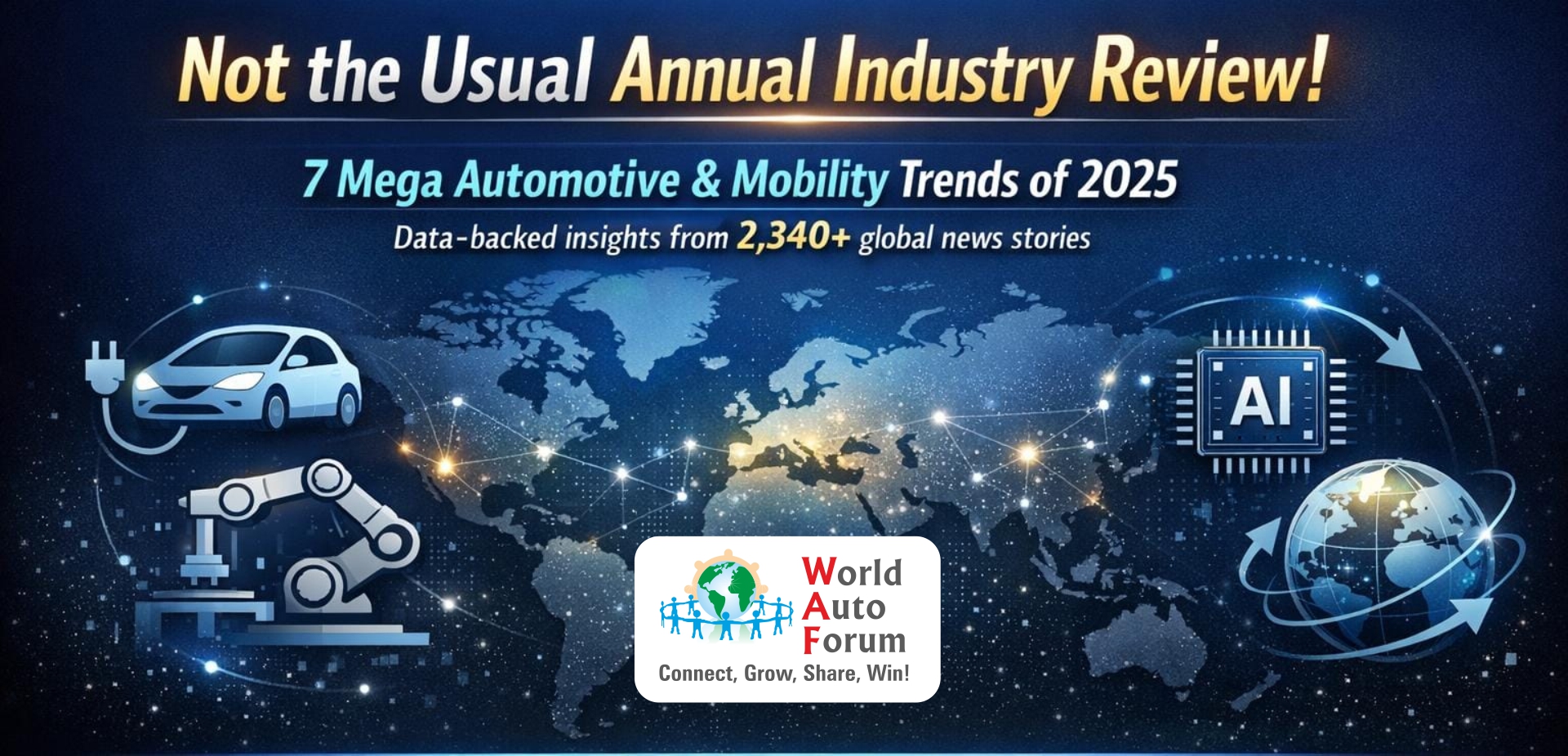
CEO’s Note
This is that time of the year when annual summaries, trend round-ups, and “Year Gone By” reports flood our feeds.
At WAF, we decided to do what we always do—think differently and use tech meaningfully.
Every Friday from 8:00 AM IST, over 250,000 WAF subscribers and community members read the WAF Auto Newsletter. Each edition curates 40–45 automotive news stories from across the globe.
Do the math:
● 40–45 news items × 52 weeks – That’s around 2,340 carefully curated stories
But we didn’t stop at curation.
We collated, assimilated, analysed, and applied trend mapping across all these stories—and whoa! What emerged are 7 Mega Automotive Trends across 2025 – clear, crisp & data-backed!
🎯 One year. One global industry. One powerful summary.
We hope you find this relevant, insightful, and truly valuable.
Wishing you a happy and prosperous 2026!

Anuj Guglani
Founder & CEO- WAF | anuj@waf.bz
1. India: The World’s Most Strategic Auto Market
QUICK FACTS!
• India vehicle sales crossed 25 million units in FY25
• EV sales approached 2 million units, led by 2Ws and 3Ws
• SUVs formed nearly 65–70% of PV sales
• India exported vehicles to over 65 countries
India strengthened its position as the fastest-evolving auto market globally. EV adoption accelerated across two-wheelers, three-wheelers, buses, and affordable passenger vehicles. OEMs adopted a multi-technology approach spanning EVs, hybrids, CNG, biofuels, and hydrogen. India also emerged as a global hub for R&D; electronics, batteries, and semiconductor investments, supported by policy reforms in road safety, tolling,scrappage, and EV Policy 2.0.
2. Electric Vehicles: Reality Check Year
QUICK FACTS !
• Global EV sales exceeded 17 million units, an increase of 25% and a market share of 20%
• India EV penetration reached ~7–8% overall
• China accounted for more than 70% of global EV production
• EV price cuts in China averaged 15–25%
2025 marked a recalibration for electric vehicles. While EV growth moderated in Europe and North America, India and China drove global momentum. Infrastructure readiness, battery economics, rare-earth dependencies, and affordability emerged as key constraints. OEMs increasingly leaned on hybrids and transitional technologies to balance growth and profitability.
3. China and the Global Price War
China remained the epicentre of auto disruption. Aggressive pricing, fast-charging innovations, and advanced ADAS offerings intensified competition. Chinese OEMs expanded rapidly across Europe, Asia, the Middle East, and Latin America, triggering tariff responses and regulatory scrutiny worldwide.
4. Global Trade, Tariffs and Geopolitics
QUICK FACT
• US imposed 25% tariffs impacting global auto supply chains
The return of protectionist trade policies, particularly US auto import tariffs, significantly altered global supply chains. Automakers were forced to reassess localization strategies, pricing structures, and capital allocation. Geopolitics became as influential as technology in determining vehicle costs and market competitiveness.
5. Legacy OEMs Under Pressure
Traditional automakers faced margin pressure, restructuring, leadership changes, and portfolio rationalization.
Software-defined vehicles, AI integration, cybersecurity, and advanced driver assistance systems became central to future competitiveness.
6. Autonomous, AI and Software-Defined Mobility
QUICK FACTS
• Robotaxi pilots expanded across 10+ global cities
• AI adoption accelerated across manufacturing and ADAS
• Robotaxi Rethink triggered after the Dec 20 Waymo Power Outage incident at San Francisco
Autonomous mobility progressed cautiously in 2025. Robotaxi pilots expanded under tighter regulatory oversight. Artificial intelligence moved beyond vehicles into manufacturing, logistics, supply chains, and customer engagement, reinforcing software as a core differentiator.
The Dec 20 incident of Mass Robotaxis stalling and holding up traffic consequent to the San Francisco Power Outage incident sent the policy makers and tech cos running to their work tables. Surely a rethink, a redesign of rollout, standards, testing and tech required!
7. Sustainability Beyond Electrification & Consumer-Centric Mobility
QUICK FACTS
• India ethanol blending crossed 20%, in July 2025, five years ahead of target deadline
• Battery recycling and circular mobility gained policy focus
Sustainability conversations broadened beyond EVs to include biofuels, ethanol blending, compressed biogas, hydrogen trucks, battery recycling, and circular mobility.
ESG compliance increasingly influenced funding, partnerships, and long-term viability.
Consumer awareness, safety, transparency, and trust emerged as critical themes.
Dealer ratings, crash safety, ADAS education, fair pricing, and digital engagement gained prominence, reinforcing the shift toward informed and empowered customers.
2025 in One Line –
“The automobile industry in 2025 proved that mobility is no longer just about
vehicles—it is about technology, geopolitics, sustainability, and trust.”
DID YOU KNOW!?
Top Auto & Mobility Cos are Annual Partners at WAF! | Ask Team WAF how! | Sheenu Kamra | hi@waf.bz | 9810714455