

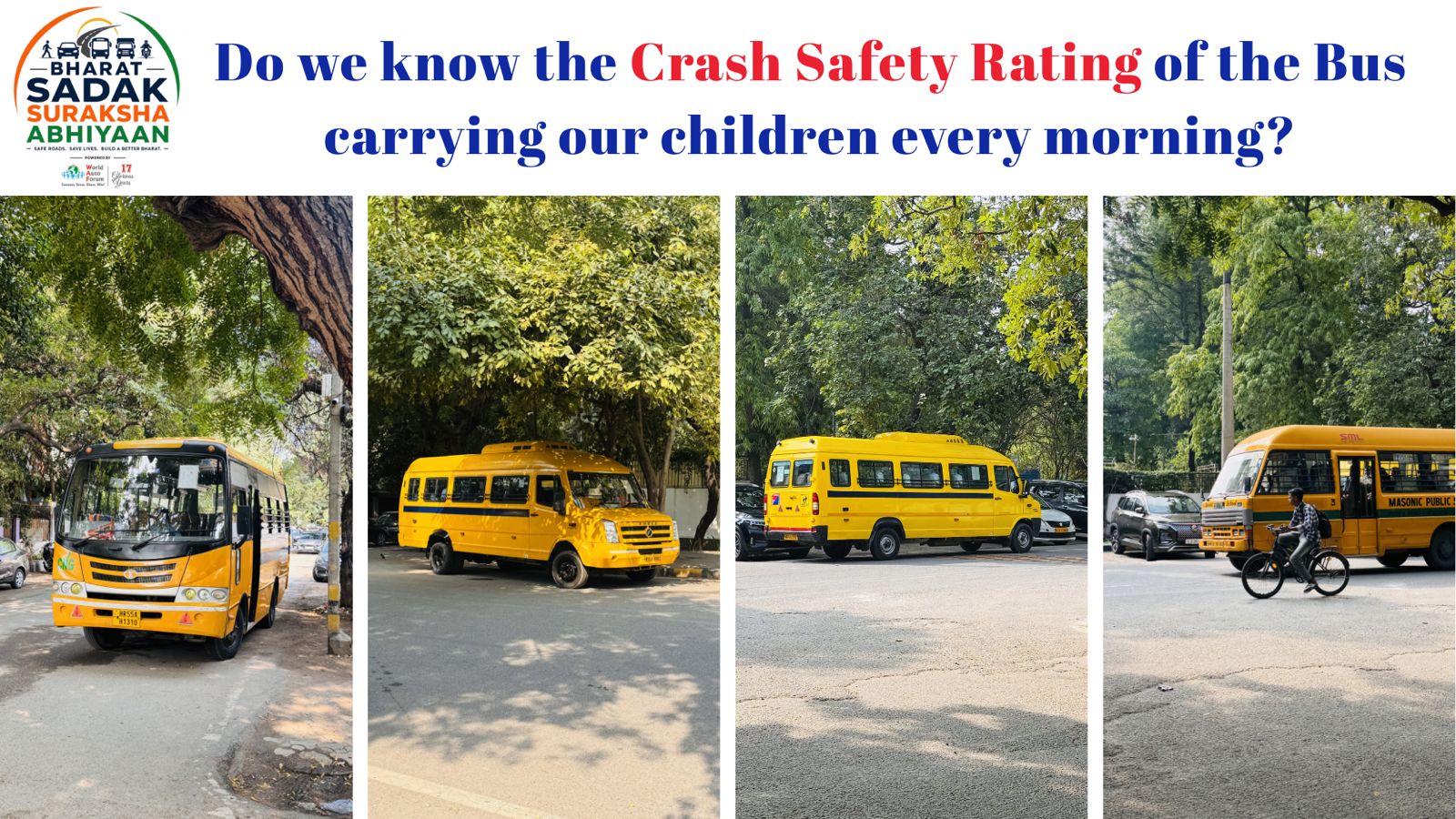

So What are the Current requirements for School Buses ?
School buses must comply with:
- The School Bus Code (AIS-063)
- Structural and body-building standards (AIS-052)
- Relevant Central Motor Vehicle Rules (CMVR)
- Bus Body Code requirements
And this what they basically cover:
- Emergency exits
- Fire extinguisher
- First aid box
- Seat dimensions
- Guard rails
- Anti-skid flooring
- Colour (yellow)
- Speed governor
- Reflective markings
- Stop signal
- Handrails
These are important, but they do not equate to proving crashworthiness.
Hon’ble Minister Gadkari – For Your Kind Attention and Action Please :
There is currently no widely implemented mandatory requirement for every school bus model to demonstrate:
- Full frontal crash test
- Side impact crash test
- Rear impact test
- Dynamic rollover test
- Roof crush/roof strength test (similar to FMVSS 220 in the U.S.)
- Occupant injury assessment using child crash dummies
- Electronic Stability Control (ESC)
- Autonomous Emergency Braking (AEB)
- Lane Departure Warning
- Advanced Driver Monitoring Systems
Roof collision / rollover protection – Most Imp for a School Bus
This is particularly important because school buses have:
- High centre of gravity
- Many child occupants
- Risk of rollover in high-speed crashes
Anuj Guglani, CEO, WAF Group said, ‘How many Vihaan’s before we wake up ? Countries such as the United States require specific roof strength standards (e.g., FMVSS 220) to ensure the roof maintains survival space during a rollover. India’s regulations include structural requirements for bus bodies, but there is no equivalent publicly available mandatory dynamic rollover or roof crush performance rating in India comparable to leading international crash standards.’
He added, ‘This is an issue that deserves much greater attention. India transports millions of school children every day, yet parents usually know:
- the school’s reputation,
- the driver’s experience,
- or whether GPS is fitted,
but rarely know how the bus itself would perform in a serious collision or rollover.’
As part of the World Auto Forum’s Bharat Sadak Suraksha Abhiyaan (BSSA) , India demands to know
“The Crash Safety Rating of the bus carrying our children every morning”
It raises an important policy discussion on whether India should introduce:
- Independent crash ratings for school buses.
- Mandatory roof-strength and rollover testing.
- Child occupant protection standards.
- Safety star ratings for school buses, similar to passenger cars.
Such a framework could significantly improve transparency and encourage manufacturers and fleet operators to prioritise crashworthiness alongside compliance.
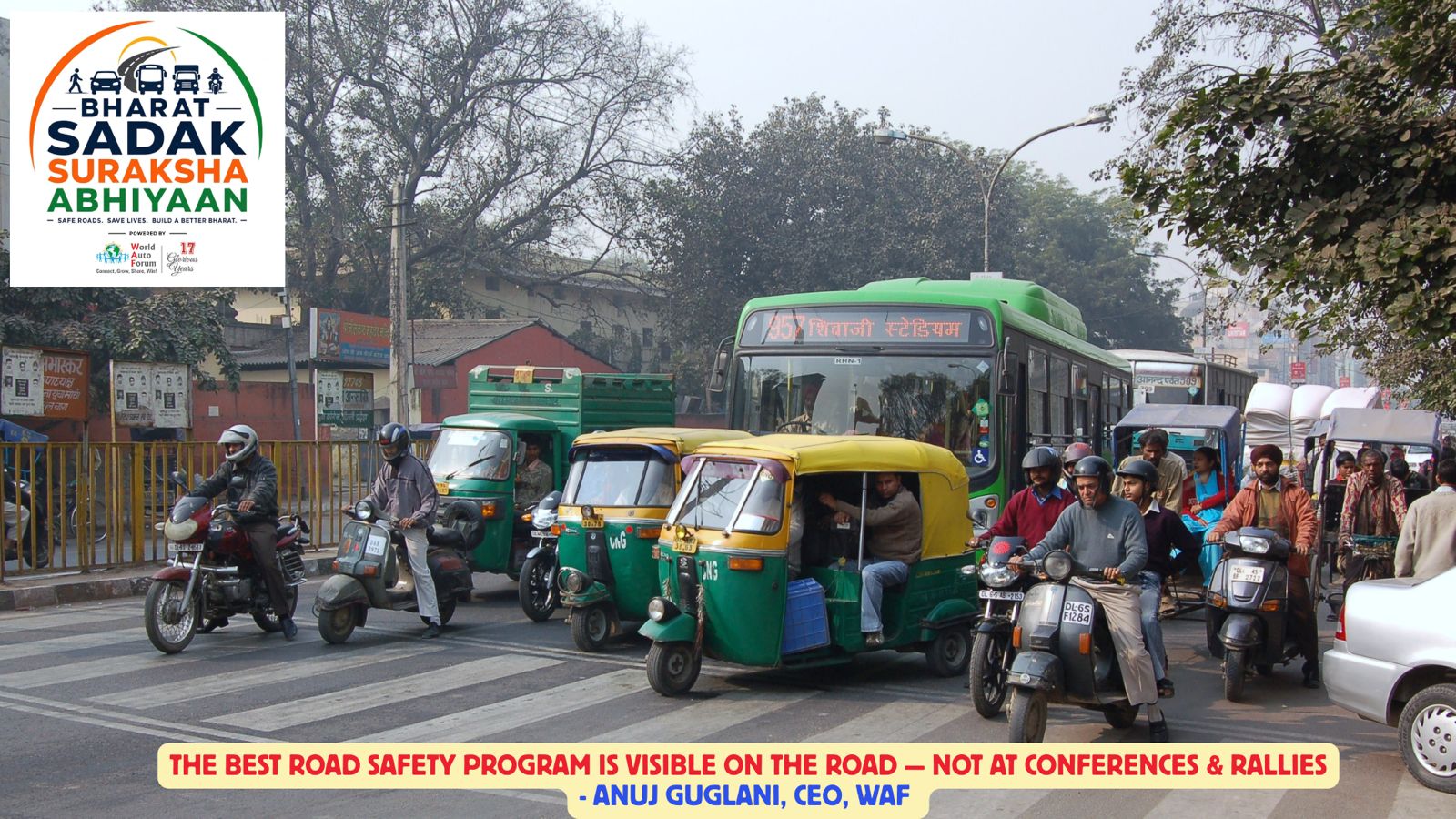
Time for a Global Benchmarking on School Buses Safety Standards
In many developed markets, school buses are subject to significantly more stringent crashworthiness and structural integrity requirements than those currently mandated in India, although the exact requirements vary by country.
Here’s how some major regions compare:
| Country/Region | Full Crash Test | Roof Strength Test | Rollover Test | School Bus Safety Rating |
|---|---|---|---|---|
| 🇺🇸 United States | Not full vehicle NCAP, but extensive federal safety standards | ✅ Mandatory | Indirect structural compliance | No star rating |
| 🇨🇦 Canada | Similar to U.S. | ✅ Mandatory | Structural requirements | No |
| 🇪🇺 European Union | Many buses undergo crash and rollover compliance | ✅ Yes (UNECE) | ✅ UNECE R66 | No public star rating |
| 🇦🇺 Australia | ADR structural standards | Yes | Yes | No |
| 🇯🇵 Japan | High structural standards | Yes | Yes | No |
| 🇮🇳 India | No mandatory public crash testing | Limited structural requirements | No mandatory dynamic rollover testing | No |
United States – Probably the world’s safest school buses
The U.S. does not rely on NCAP-style crash ratings for school buses. Instead, manufacturers must comply with a comprehensive set of Federal Motor Vehicle Safety Standards (FMVSS).
Some of the most important include:
FMVSS 220 – Roof Crush Resistance
This standard requires the roof structure to withstand substantial vertical loads without excessive deformation, preserving survival space for occupants during a rollover.
FMVSS 221 – Body Joint Strength
Ensures that body panels remain attached during severe crashes.
FMVSS 222 – Passenger Seating and Crash Protection
One of the most famous standards, it introduced compartmentalization:
- High padded seat backs
- Energy-absorbing seats
- Controlled spacing between seats
- Protection without relying solely on seat belts
Fuel System Integrity
The fuel system must resist leakage after specified crash conditions.
Emergency Exits
Strict standards govern:
- Rear emergency doors
- Roof hatches
- Side exits
- Window exits
Europe
Europe follows UNECE regulations, which are among the world’s most demanding.
UNECE R66
This regulation specifically addresses rollover strength.
Manufacturers either:
- physically roll a bus,
or - demonstrate compliance using validated computer simulations.
The objective is to ensure that a survival space remains intact after a rollover.
Roof impact testing
This is one of the most critical aspects of bus safety.
The tests evaluate whether:
- the roof collapses,
- pillars buckle,
- windows pop out,
- passenger survival space is maintained.
A weak roof can turn a survivable rollover into a fatal accident.
Side impact and frontal crash
Many countries require:
- structural calculations,
- sled testing,
- component testing,
- occupant protection validation.
Some manufacturers also conduct full-scale crash tests voluntarily during development.
What about child occupants?
Leading school buses are designed with:
- energy-absorbing seats,
- padded interiors,
- improved seat anchorage,
- stronger roof structures,
- protected fuel systems,
- multiple emergency exits,
- rollover-resistant body shells.
Many newer buses also include:
- Electronic Stability Control (ESC),
- Automatic Emergency Braking (AEB),
- Collision Warning Systems,
- Driver fatigue monitoring,
- 360° cameras.
Where does India stand?
India has made significant progress in:
- bus body construction standards,
- emergency exits,
- fire safety,
- speed governors,
- GPS tracking,
- CCTV requirements in many states.
However, there is currently no publicly available school bus crashworthiness programme equivalent to FMVSS or UNECE R66 that requires manufacturers to demonstrate rollover survival or publish crash performance for school buses.
Parents need to ask –
Given that millions of children travel to and from school every day, should India introduce a School Bus Safety Rating Program, similar to the star ratings for passenger cars?
Such a program could evaluate buses on:
- Frontal crash protection
- Side-impact protection
- Roof crush resistance
- Rollover performance
- Seat and restraint systems
- Emergency evacuation
- Fire safety
- Advanced driver-assistance systems (ADAS)
“Parents know the school’s academic rating. Shouldn’t they also know the safety rating of the bus that carries their children every day?”
It shifts the conversation from basic regulatory compliance to measurable crash safety and occupant protection.
An anxious parent averred,’Make all the MPs and MLAs should be made to commute by bus. This shall surely change things!’