
Bodyshop capacity has become a strategic concern for OEMs and dealer networks alike, not just a floor-level scheduling issue. Technician availability is tightening, repair complexity is rising, and customer expectations on turnaround time continue to climb — regardless of brand or market.
The question dealer networks now face isn’t just “how do we hire more technicians” — it’s “how do we get measurably more output from the technicians already on the floor, without compromising quality or consistency?”
This is where a standardized, process-led approach to sanding and finishing — built around Kovax’s abrasive systems — presents a compelling and directly measurable case.
Why a Headcount-Led Approach Falls Short
Adding technicians to grow capacity carries costs that rarely show up as a single line item, but compound significantly at network scale:
- Hiring and training lag: Skilled technicians take months to recruit and longer to reach full productivity.
- Inconsistent output: Capacity gained through headcount still varies with individual skill and technique.
- Rising fixed cost: Every additional technician adds payroll cost that scales linearly, not marginally.
- Limited by physical space: More technicians only help if bay capacity can absorb them.
These pressures don’t just slow growth — they cap how quickly a Bodyshop, or a dealer network, can respond to rising demand.
Where Technician Time Actually Goes
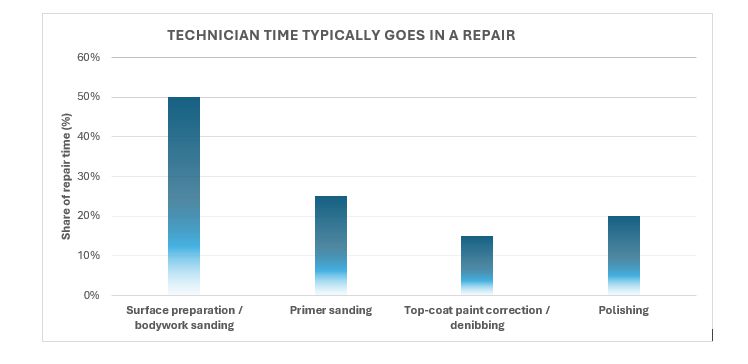
Sanding and finishing aren’t one task — it’s a sequence, and each stage quietly adds to total repair time. Seeing where that time concentrates is the first step to reducing it.
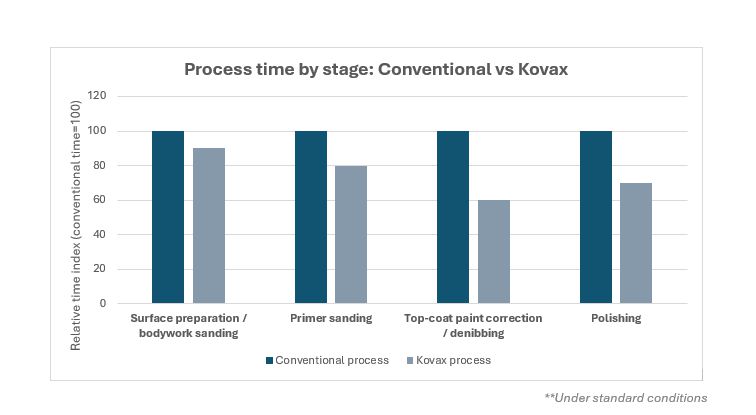
Across these four stages, shifting to Kovax abrasive system practices delivers an overall technician time saving of approximately 20% — recovered from existing capacity rather than added headcount.
The Dealer-Level Financial Impact
For an individual dealer Bodyshop, a technician-hour recovery of this kind typically shows up in three ways:
- Additional repair capacity — more job cards completed per month from the same headcount.
- Lower rework rates — protecting both margin and customer satisfaction scores.
- Deferred hiring cost — capacity growth without a proportional increase in payroll.
Even a modest recovery in technician-hours, multiplied across a dealer’s monthly job volume, translates into meaningful additional throughput — without added headcount or floor space.
A simulated calculation of Turnaround of an average Bodyshop with Kovax Abrasive Sanding System.
For an individual dealer Bodyshop that repairs 200 cars per month, with an average repair cost of ₹15,000 per car.
| Metric | Value |
| No. of job cards per month | 200 |
| Technicians on floor | 7 Nos |
| Working hours per day | 7.5 Hours |
| Working days per month | 24 Days |
| Total technician-hours per month | 1260 Hours |
| Average repair revenue per job | ₹15,000 |
| Monthly body & paint revenue | ₹30,00,000 |
Expected additional revenue with a 20% technician-hour recovery:
| Basis | Monthly Additional Revenue | Annual Additional Revenue |
| 20% technician-hour recovery via Kovax Sanding process (~40 cars/month x ₹15,000) | +₹6,00,000 | +₹72,00,000 |
Capacity and Profitability
| Extra Job cards / month
+40 |
Value / Job card
₹15,000 |
Additional Revenue / month
₹6.0L |
Additional Revenue / year
₹72.0L |
40 additional cars a month, worth ₹6.0L in extra monthly profit — from the same 7-painter team, with no new hires.
Bodyshop profitability isn’t solved by adding more people to the floor — it’s solved by extracting more output from the people already there. A standardized, Kovax-led sanding and finishing process addresses the operational core of that equation directly, making it a strong candidate for network-wide standardization.